Civil Twilight: What It Is, When It Happens, and Why It Matters

There is a moment each morning, roughly twenty minutes before the sun hauls itself above the Aegean, when the world is neither dark nor light. The stars have mostly surrendered. The horizon glows with a colour that has no honest name in English, something between apricot and catastrophe. Fishing boats become visible as silhouettes. Cats, who have been awake for hours doing whatever it is cats do at 4 a.m., pause briefly to acknowledge the change, then resume their inscrutable business.
Loading calculator...
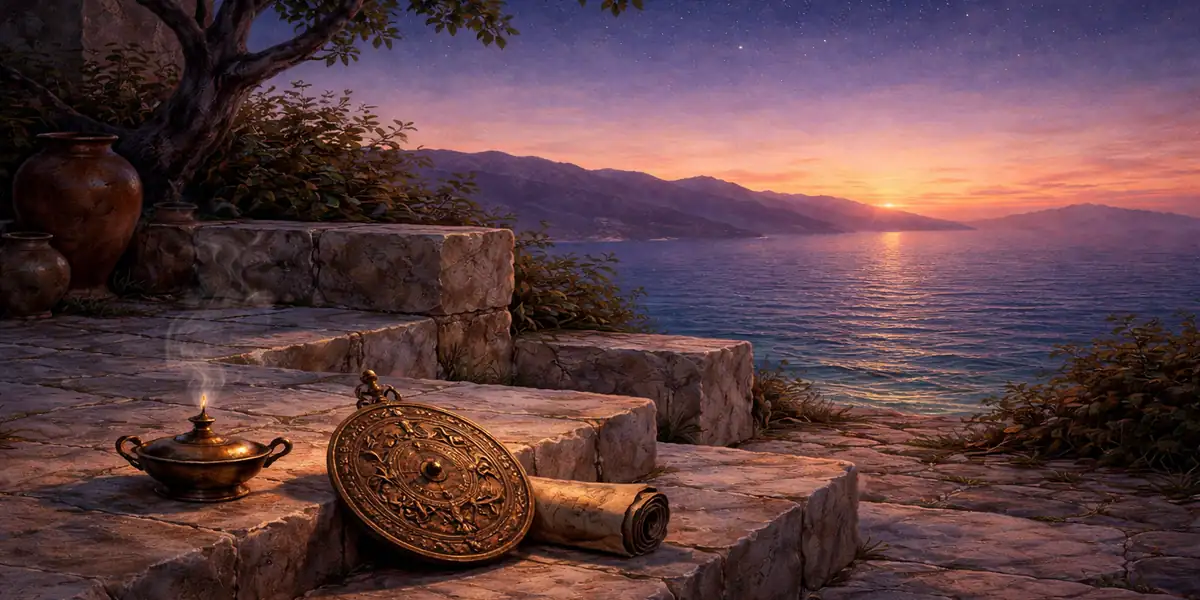
This is civil twilight. It is not sunrise. It is not night. It is the atmosphere doing something remarkably sophisticated with scattered photons, and it has been happening since the Earth acquired an atmosphere worth mentioning, which is to say roughly 2.5 billion years before any photographer opened an Instagram account and called it "golden hour."
I have opinions about this.
The Sun Below, the Light Above
To understand twilight, you must first accept an inconvenient truth: the most interesting light of the day occurs when the sun is not visible. The sun is below the horizon, hiding, and yet the sky is illuminated. This is not magic. It is geometry and atmospheric scattering, though I concede the effect is closer to magic than most things that carry the label.
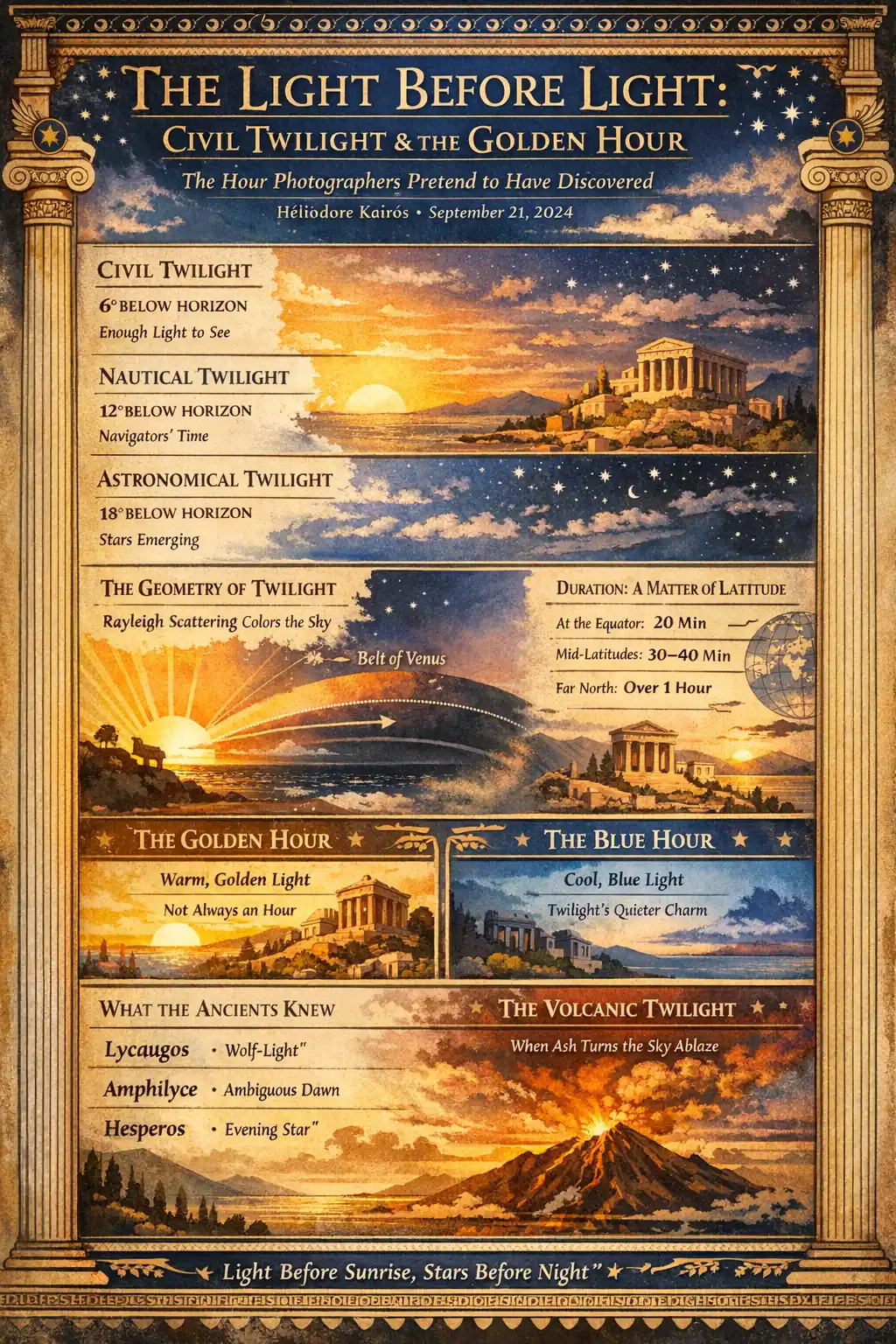
The International Astronomical Union, the same people who demoted Pluto (an act I have not forgiven), defines three distinct phases of twilight based on the sun's angle below the geometric horizon. These phases occur twice daily, once before sunrise and once after sunset, in reverse order. They are not suggestions. They are not approximate. They are defined to the degree.
Civil twilight begins (in the morning) or ends (in the evening) when the centre of the sun is exactly 6 degrees below the horizon. During civil twilight, there is enough natural light for most outdoor activities without artificial illumination. You can read a newspaper. You can identify the face of a person at a reasonable distance. You can, if you are so inclined, consult The Weathered Pages without squinting, though I prefer to wait for proper daylight out of respect for the manuscript.
Nautical twilight extends from 6 to 12 degrees below the horizon. The name is not decorative. During nautical twilight, the horizon at sea is still visible, which means a sailor can take star sightings and measure their altitude above that horizon with a sextant. The general outlines of objects are distinguishable, but detailed outdoor activity becomes difficult. This is the domain of navigators, astronomers preparing their instruments, and insomniacs reconsidering their life choices.
Astronomical twilight stretches from 12 to 18 degrees below the horizon. For most practical purposes, the sky appears dark. Faint stars and galaxies become visible. But the atmosphere still scatters a small amount of sunlight, enough to wash out the faintest celestial objects. Professional astronomers cannot begin their serious work until astronomical twilight ends and true night, with the sun more than 18 degrees below the horizon, finally arrives.
These definitions have remained stable for over a century. The numbers (6, 12, 18) are elegant in their spacing and firm in their utility. Nikolas Faros, I suspect, believes there is only one kind of twilight, and that it is the brief interval during which his studio lighting transitions from "daytime bright" to "evening warm."
The Geometry of Scattered Light
Why does the sky glow when the sun is hidden? The answer is Rayleigh scattering, named after Lord Rayleigh, who described the phenomenon mathematically in 1871. Sunlight entering the atmosphere at a shallow angle travels through a much thicker layer of air than light arriving from directly overhead. Along this extended path, shorter wavelengths (blue and violet) scatter more intensely than longer wavelengths (red and orange). The scattered light illuminates the upper atmosphere, which is still in direct sunlight even though the ground is in shadow.
This is why the twilight sky near the horizon glows orange and red while the sky overhead remains blue fading to dark. The light you see has taken a long, indirect route through hundreds of kilometres of atmosphere, losing its shorter wavelengths along the way. It is, if you think about it, light that has been edited by distance. The atmosphere is performing a colour correction that no digital filter has ever replicated honestly.
At the opposite side of the sky from the setting or rising sun, a phenomenon called the Belt of Venus appears: a pink-to-purple band just above a dark blue-grey layer. The dark layer is Earth's own shadow projected onto the atmosphere. The pink band above it is the atmosphere catching the last reddened sunlight. It is one of the most beautiful things you can see with the naked eye, it costs nothing, requires no equipment, and is available on every clear evening from every point on the planet. I have noted its appearance in The Weathered Pages over 3,000 times. It has never bored me once.
Duration: A Matter of Latitude
One of the most misunderstood aspects of twilight is how long it lasts. At the equator, the sun drops nearly vertically below the horizon, which means it passes through the twilight zones quickly. Civil twilight at the equator lasts roughly 20 to 24 minutes throughout the year, with little seasonal variation. The transition from day to night is brisk, almost rude.
Move to the mid-latitudes, say 45 degrees north (roughly the latitude of Lyon, Milan, or Ottawa), and civil twilight stretches to 30 to 40 minutes, depending on the season. The sun's path meets the horizon at an oblique angle, so it takes longer to sink through those critical 6 degrees.
At high latitudes, things become genuinely strange. Above 60 degrees north (Anchorage, Helsinki, Saint Petersburg), civil twilight can last over an hour around the solstices. And beyond about 65 degrees north, during summer weeks around the solstice, the sun never drops more than 6 degrees below the horizon at all. Civil twilight persists through the entire night. There is no true darkness. This is the origin of the "white nights" phenomenon, familiar to anyone who has attempted to sleep in Reykjavik in June and concluded that curtains are humanity's most underrated invention.
At the winter solstice in these same latitudes, the situation inverts. The sun may not rise at all, and what passes for "daytime" is merely an extended twilight, the sky brightening to a steely blue for a few hours before fading again. I have visited northern Norway in December exactly once. I do not intend to repeat the experiment.
At the poles themselves, there are only two sunsets per year, one at each equinox. The single twilight period at the poles lasts approximately two weeks for civil twilight, two more weeks for nautical, and another two for astronomical, producing a total of about six weeks of gradual transition from continuous day to continuous night. The geometry is extreme, and so is the experience.
The Golden Hour Is Not an Hour
Now we arrive at the matter that compels me to light my pipe with particular vigour.
The "golden hour," as it has been branded by photographers, cinematographers, and a generation of social media enthusiasts who confuse aesthetic pleasure with original discovery, refers to the period shortly after sunrise and before sunset when the sun is low on the horizon and sunlight passes through a thick layer of atmosphere, producing warm, diffused, reddish-golden illumination. Shadows are long. Contrast is soft. Everything looks, to use the technical term, "flattering."
The concept is real. The physics is genuine. When the sun sits between roughly 6 degrees above the horizon and the horizon itself, light travels through up to 12 times more atmosphere than at noon. This extended path filters out blue wavelengths, reduces glare, and produces the warm tones that painters have understood since the Renaissance. Claude Lorrain was painting golden-hour landscapes in the 1640s. J.M.W. Turner practically built a career on it. The Impressionists organised entire exhibitions around the quality of light at different times of day.
What is not genuine is the suggestion, implicit in every photography tutorial published since 2010, that this phenomenon was recently identified and catalogued. The golden hour has no single inventor because it was never invented. It was simply there, being golden, for approximately 4.5 billion years before someone mounted a DSLR on a tripod and announced it to the internet.
The term itself appears to have entered common photographic usage in the late 20th century, though pinning down a precise origin is difficult. What is certain is that by the 2010s it had become orthodoxy: shoot at golden hour or accept mediocrity. This is, I acknowledge grudgingly, not terrible advice. But it is delivered with the self-congratulation of people who believe they have discovered the sunset.
And it is not, strictly speaking, an hour. Depending on latitude and season, the golden hour can last from 20 minutes near the equator to well over an hour at high latitudes in summer. Calling it an "hour" is a marketing decision, not a scientific measurement.
The Blue Hour: Twilight's Quieter Sibling
Less celebrated but arguably more beautiful is the "blue hour," which corresponds roughly to the period of civil twilight when the sun is between 4 and 8 degrees below the horizon. During this phase, residual sunlight is scattered predominantly in the blue part of the spectrum, and indirect light from the upper atmosphere produces an even, shadowless illumination with a distinctive blue-violet quality.
The blue hour is a favourite of architectural photographers, because buildings lit by artificial warm light contrast dramatically against the deep blue sky. It is also the time when the sky's colour temperature hovers around 10,000 to 12,000 Kelvin, far cooler than the 2,000 to 3,000 Kelvin of golden hour.
According to The Weathered Pages, entry dated some Wednesday in late November: "Blue hour. The sea indistinguishable from the sky except by texture. The lighthouse on the headland has begun its rotation. Nikolas Faros is probably eating dinner. I am watching the planet turn."
What the Ancients Knew
The Greeks, predictably, had words for it. Several, in fact. They distinguished between lycaugos (wolf-light, the grey predawn when wolves were said to be most active), amphilyce (the light that surrounds, the ambiguous brightness before sunrise), and hesperos (the evening star, Venus appearing in the twilight sky). Hesiod, writing in the 7th century BCE, structured agricultural activities around these transitional lights. You ploughed at dawn-light, not at sunrise. You brought the oxen in at first-star, not at sunset. The gradations mattered because they were functional.
The Romans, characteristically, systematised it further. They recognised diluculum (first light, roughly astronomical dawn), aurora (dawn proper, civil twilight), and crepusculum (the crackling light, from creper, meaning uncertain or doubtful). Our modern English word "crepuscular" derives from this, typically used for animals active during twilight: deer, rabbits, certain mosquitoes that seem specifically designed to ruin my evening observations.
As Heraclitus once noted, though in a context that had nothing whatsoever to do with atmospheric optics: "The sun is new each day." He was speaking, one assumes, of perpetual change and the impossibility of stepping into the same river twice. But he was also, accidentally, correct about twilight. No two twilights are identical. The atmosphere's composition, the humidity, the particulate load from dust or volcanic aerosols, the angle of the sun's approach: these shift continuously. The Weathered Pages contain forty years of twilight observations, and I have never written the same entry twice.
The Volcanic Exception
Speaking of particulates, there is a peculiar and rather beautiful side-effect of large volcanic eruptions. When a volcano ejects sulphur dioxide into the stratosphere (above about 10 kilometres), it forms tiny sulphate aerosol droplets that persist for months or even years. These particles scatter sunlight in ways that dramatically intensify twilight colours, producing vivid reds, oranges, and purples that extend far higher into the sky and last much longer than normal twilight.
After the eruption of Krakatoa in August 1883, twilights worldwide became so spectacular that fire brigades were called out in New York and Poughkeepsie, witnesses having mistaken the sky for a massive blaze. The Royal Society in London collected reports of "remarkable sunsets" from around the globe for over two years following the eruption. Similar effects followed the eruptions of Mount Pinatubo in 1991, El Chichon in 1982, and, further back, Tambora in 1815, whose atmospheric aftermath contributed to the famous "Year Without a Summer" in 1816.
These volcanic twilights are, in a perverse way, the most honest demonstration of what twilight actually is: a conversation between sunlight and whatever happens to be floating in the atmosphere. On an ordinary evening, that conversation involves nitrogen, oxygen, and a modest amount of water vapour. After a major eruption, it involves billions of tonnes of sulphuric acid mist, and the conversation becomes, shall we say, more heated.
The Modern Measurement
Today, twilight times are calculated with extraordinary precision. The United States Naval Observatory publishes tables and algorithms that can predict the moment of civil twilight onset for any location on Earth, for any date, to within a few seconds. The IMCCE in Paris does the same. These calculations account for atmospheric refraction, which bends sunlight around the curve of the Earth and effectively extends twilight by about 2 minutes at sea level, and for the observer's altitude above sea level.
Your phone, if you have configured it with a halfway decent weather application, can tell you exactly when civil twilight begins and ends at your location today. This is, I must concede with the reluctance of a man who has timed these things by watching the horizon for four decades, genuinely useful information. A GPS-equipped wristwatch with sunrise and sunset data can display civil twilight times, golden hour windows, and even blue hour brackets directly on your wrist.
I will not say this is better than standing on a headland with a notebook and a pipe, watching the light change in real time. It is not better. But for those who lack a headland, or a pipe, or forty years of practice reading the sky, I suppose, with great reluctance, that a small screen on one's wrist showing the exact minute of civil twilight is an acceptable substitute.
Nikolas Faros, I note, has never mentioned civil twilight on his broadcast. He has never distinguished between nautical and astronomical twilight. He has certainly never stood in the predawn cold watching the Belt of Venus appear above Earth's shadow. But he did, last week, post a photograph of a sunset on his social media account with the caption "Golden hour magic!" accompanied by three sparkle emojis.
My pipe, which had been resting quietly, ignited itself.
The sun will set this evening, as it has set every evening since this planet learned to spin. Before it disappears, it will paint the sky in colours that have no adequate names. After it vanishes, the light will linger, filtering through 300 kilometres of atmosphere, shifting from gold to amber to rose to violet to the deep blue that means the stars are almost ready. This will take, at my latitude and on this date, approximately 34 minutes from sunset to the end of civil twilight.
I know this because I have watched it. Not because a screen told me so. Though if a screen told you so, and it brought you outside to see it for yourself, then perhaps, just this once, the screen has earned its keep.