Hibernation and the Body That Slows Down

There is, I have long maintained, a profound dignity in doing absolutely nothing. The olive tree outside my window understands this. It has not produced a single fruit since November, and I respect it enormously for that decision. But the olive tree is merely dormant. It has not, as far as I can tell, reduced its heart rate to four beats per minute, dropped its body temperature to near freezing, or gone several months without eating, drinking, or visiting the bathroom. For that level of commitment to inactivity, one must look to the hibernators.
Hibernation is one of those words that everyone believes they understand and almost no one actually does. People use it to describe bears sleeping through winter, squirrels curling up in tree hollows, and their own behaviour on a rainy Sunday in February. Nikolas Faros once described the city of Athens as "hibernating" during a mild cold snap in January, when temperatures dipped to a harrowing twelve degrees Celsius. I nearly choked on my pipe. Twelve degrees. A ground squirrel would barely notice.
The reality is far stranger, far more extreme, and far more interesting than anything a television meteorologist in a fitted suit has ever conveyed. True hibernation is not sleep. It is not rest. It is something closer to a controlled rehearsal for death, a state so deep and so alien that it challenges our very understanding of what it means to be alive.
What Hibernation Actually Is
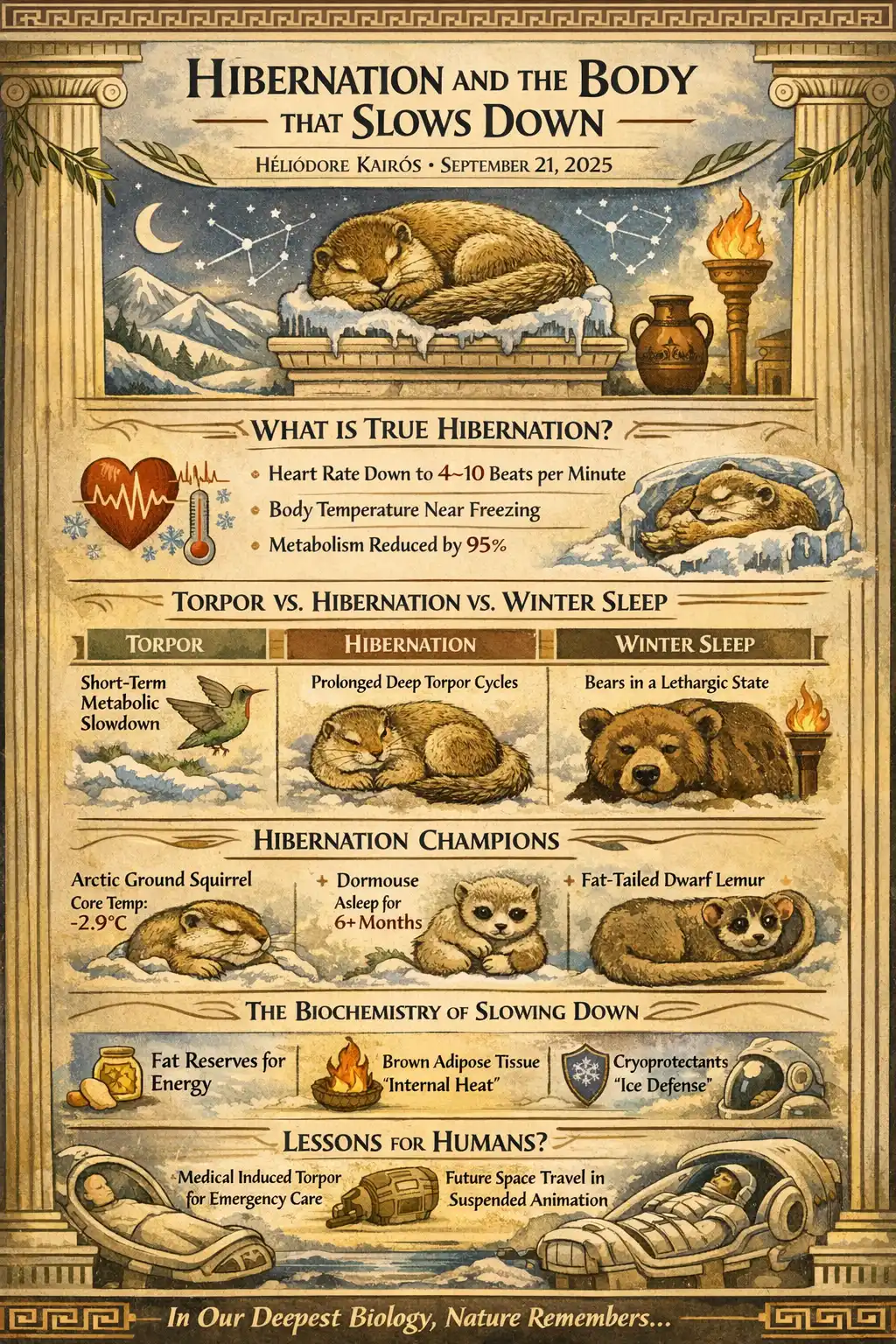
Let us begin with what hibernation is not. It is not a long nap. Sleep and hibernation are neurologically distinct states. During sleep, the brain cycles through recognisable patterns of activity. During hibernation, brain activity drops so low that an electroencephalogram reading would make a neurologist reach for the defibrillator. A sleeping animal can be woken with a nudge. A hibernating Arctic ground squirrel, body temperature hovering around minus 2.9 degrees Celsius (the lowest recorded core temperature in any living mammal), would take hours to rouse, burning precious energy reserves in the process.
True hibernation, or "deep hibernation" as physiologists prefer, involves a suite of coordinated changes so radical they border on the implausible. Heart rate plummets. The Arctic ground squirrel's heart, which normally beats around 200 times per minute, drops to roughly 10 beats. Respiration slows to perhaps one breath every few minutes. Metabolism falls to as little as 2 to 5 percent of its active rate. Body temperature, normally maintained with mammalian precision around 37 degrees Celsius, crashes to within a degree or two of the ambient temperature of the burrow. In some species, this means hovering just above zero.
The animal, in a very real biochemical sense, has turned itself off. Not dead, but operating on the faintest possible pilot light.
The Difference Between Hibernation, Torpor, and Winter Sleep
This is where things become properly interesting, and where popular understanding goes reliably wrong.
Torpor is the broader physiological state: a controlled reduction in metabolic rate, body temperature, and activity. It can last hours or days. Hummingbirds enter torpor nightly, dropping their body temperature from around 40 degrees Celsius to as low as 18 degrees to survive cool nights when they cannot feed. Common poorwills (Phalaenoptilus nuttallii), a species of nightjar, can remain torpid for weeks. Torpor is the mechanism; hibernation is its most extreme seasonal expression.
Hibernation is essentially prolonged, recurring torpor bouts interspersed with brief arousals. A hibernating ground squirrel does not simply go cold in October and warm up in April. It cycles through bouts of deep torpor lasting one to three weeks, punctuated by "interbout arousals" during which body temperature rockets back up to 37 degrees Celsius for 12 to 24 hours before the animal plunges back down again. These arousals account for roughly 80 percent of the total energy spent during the entire hibernation season. Why the animal bothers with them remains one of the great unsolved puzzles. Some researchers suspect the arousals are necessary to allow the immune system to function briefly, or to permit genuine sleep (hibernation, remember, is not sleep, so the animal may actually need to wake up in order to rest).
Winter sleep, or "winter lethargy," is what bears do. And bears, despite their cultural reputation as the quintessential hibernators, are not true hibernators at all. A black bear's body temperature during winter denning drops only modestly, from about 38 to around 31 degrees Celsius. Heart rate decreases, yes, from 40-50 beats per minute to roughly 8-10, but the bear remains relatively responsive. Disturb a denning bear and you will discover, with some urgency, that it can wake far more quickly than you can retreat. A denning bear does not eat, drink, urinate, or defecate for five to seven months, which is remarkable by any standard. But it is not the metabolic freefall of true hibernation. It is something else: a large mammal's particular, impressive, slightly terrifying solution to seasonal food scarcity.
The Champions of Hibernation
The undisputed masters are the small mammals. The Arctic ground squirrel (Urocitellus parryii) hibernates for seven to eight months in permafrost burrows, enduring core temperatures below freezing through supercooling of its blood plasma, which resists ice crystal formation. According to The Weathered Pages, entry dated some Tuesday in late November, I once attempted to explain supercooling to a fisherman at the harbour. He nodded politely and then asked if I meant the squirrel was dead. I said no. He looked unconvinced.
The alpine marmot (Marmota marmota) hibernates socially, with family groups huddling together in burrows. Juvenile marmots, too small to survive alone, rely on the warmth of adults during arousals. In a marmot family, hibernation is a collective project. There is a lesson there about community that I will not belabour, except to note that Nikolas Faros has never struck me as someone who would share his burrow.
The common dormouse (Muscardinus avellanarius) can hibernate for six months or more, sometimes longer if spring is late. Its body temperature can fall to as low as 0.5 degrees Celsius. The dormouse is so thoroughly associated with sleeping that its very name derives from the French "dormir." Lewis Carroll's Dormouse at the Mad Hatter's tea party, perpetually drowsy and stuffed into a teapot, is not entirely unfair as a characterisation, though the real animal would object to the teapot.
And then there are the surprises. The common poorwill, already mentioned, was known to the Hopi people as "Hölchko," the sleeping one, long before Western science documented avian hibernation in 1948. Madagascar's fat-tailed dwarf lemur (Cheirogaleus medius) is the only primate known to hibernate, spending up to seven months in tree hollows. Its body temperature fluctuates with the ambient temperature of the hole, sometimes swinging by 20 degrees Celsius in a single day. For a primate, a relative of ours, this is astonishing.
The Biochemistry of Slowing Down
How does an animal reduce its metabolism by 95 percent without dying? The mechanisms are numerous and, in many cases, still incompletely understood.
Before hibernation, animals undergo a period of intense preparation called "hyperphagia," during which they eat voraciously and accumulate massive fat reserves. A ground squirrel may double its body weight. This fat, primarily white adipose tissue, becomes the sole fuel source for months of torpor. It is metabolised slowly, producing water as a byproduct, which is how hibernators avoid dehydration without drinking.
Brown adipose tissue (BAT) plays a different, critical role. Located between the shoulder blades and around vital organs, BAT is a specialised heat-generating tissue. During interbout arousals, BAT activates through a process called non-shivering thermogenesis, burning fat to produce heat directly, without muscle contraction. This is how a ground squirrel can rewarm from minus 2 degrees to 37 degrees in a matter of hours.
At the cellular level, hibernators suppress protein synthesis, reduce ion channel activity, and alter the composition of their cell membranes, increasing the proportion of unsaturated fatty acids to maintain membrane fluidity at low temperatures. The blood undergoes changes too: anticoagulant compounds prevent clotting during the long periods of near-stasis, and cryoprotective molecules help prevent tissue damage from ice crystal formation.
Some researchers at the University of Alaska Fairbanks have identified specific genes, sometimes called "hibernation genes," that are upregulated during torpor. Intriguingly, many of these genes have homologs in non-hibernating mammals, including humans. We carry, in our genome, echoes of a capacity for torpor that evolution has apparently mothballed rather than deleted.
What Hibernation Reveals About Time
This is the point at which I must, with some reluctance, venture beyond the merely physiological. Because hibernation poses a philosophical question that has nagged at me through many a winter evening, pipe in hand, staring at the Aegean.
What is time to a hibernating animal?
A ground squirrel that enters its burrow in September and emerges in May has, in subjective terms, experienced almost nothing during those eight months. Its brain was barely active. It formed no memories. It perceived no passage of hours or days. For the squirrel, autumn and spring are separated by, effectively, nothing. It stepped through a door in September and emerged on the other side in May, six months older in body but with no experiential record of the interval.
Heraclitus wrote that time is a child playing, arranging pieces on a board. I have always found this irritatingly cryptic, but the hibernating squirrel adds a twist that I suspect even Heraclitus did not anticipate: what happens to the game when the child is not merely distracted but functionally absent? Does the board persist? Does the game continue?
For the natural world outside the burrow, of course, time marches on. Snow falls and melts. The Earth completes half its orbit. Predators hunt. Rivers freeze and thaw. But for the sleeper in the dark below the permafrost, none of this happens. It is the most radical opt-out from temporal experience that biology has devised, short of actual death.
The Medical Promise of Induced Torpor
The fact that hibernators can endure conditions that would kill a non-hibernating mammal, near-freezing body temperatures, barely detectable heart rates, months without food or water, has not escaped the attention of medical researchers.
If we could induce a torpor-like state in humans, the applications would be transformative. Trauma surgeons dream of "buying time" for severely injured patients by slowing their metabolism during transport. Space agencies, NASA among them, have funded research into synthetic torpor for long-duration space missions. A crew in torpor would need less food, less water, less oxygen, less psychological support, and less shielding from cosmic radiation (since cellular processes, including radiation damage repair, slow with metabolism).
In 2014, researchers at the University of Alaska Fairbanks identified a molecule called "Hibernation Induction Trigger" (HIT), though its exact nature and mechanism remain debated. More recently, in 2020, a team at the University of Tsukuba in Japan demonstrated that stimulating specific neurons in the hypothalamus (Q neurons) could induce a torpor-like state in mice, animals that do not naturally hibernate. The mice survived, recovered fully, and showed no neurological damage. This was, by any measure, a remarkable result.
We are not there yet. Human physiology differs from that of a ground squirrel in ways that make induced torpor deeply challenging. Our hearts, for instance, tend to fibrillate fatally at temperatures below about 28 degrees Celsius, while a hibernator's heart keeps beating calmly at temperatures 30 degrees lower. But the research is serious, well-funded, and progressing.
The Reluctant Concession
I have spent the last forty years observing the rhythms of the natural world with my own eyes, my own notebooks, and my own stubbornly analogue instruments. I have recorded the dates when the swallows depart and return, when the first frost silvers the bougainvillea, when the sea changes colour from summer's hard blue to winter's grey-green. I know these rhythms in my bones.
But I will concede, with the same enthusiasm I reserve for dental appointments, that a modern smartwatch can track biological rhythms that are invisible to the naked eye. Heart rate variability. Skin temperature fluctuations across seasons. Sleep architecture, with its own nightly torpor-like dips in metabolic activity. Your wrist, whether you asked it to or not, is quietly documenting your body's own seasonal slowdowns, those subtle shifts in recovery time, resting heart rate, and sleep depth that echo, faintly but unmistakably, the ancient mammalian heritage we share with the dormouse and the marmot.
You are not hibernating. You will never hibernate. But your body remembers, in its deep chemistry, a time when slowing down was not laziness but survival. And if a small device on your wrist can make that invisible rhythm visible, well. I suppose that is not entirely without value.
My pipe, I notice, has gone out. The olive tree is still doing nothing. We understand each other.