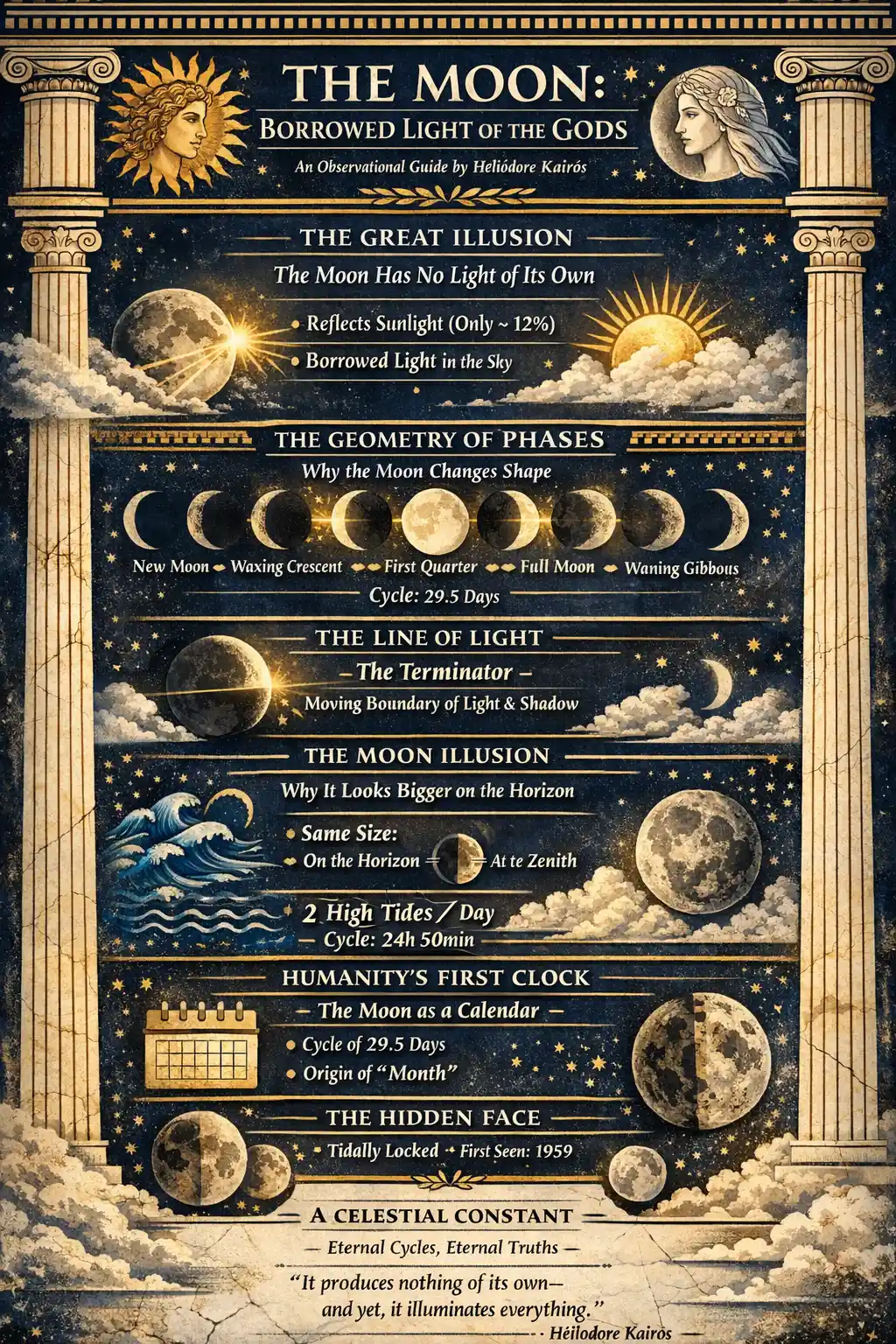
The Moon Has No Light of Its Own
I feel compelled to begin with an admission. The moon, that serene disc I have watched from my terrace for more decades than I care to count, produces absolutely nothing. No light. No warmth. No original thought. In this respect, it shares a surprising amount with Nikolas Faros, though the moon is considerably more reliable.
Loading calculator...
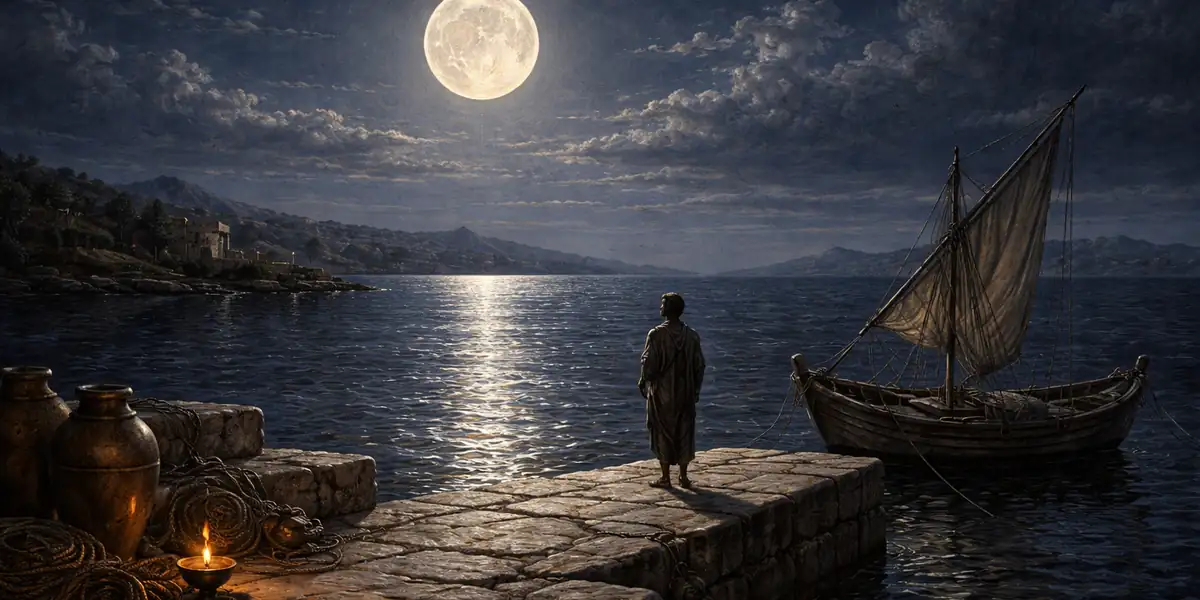
What the moon does, with a consistency that would embarrass most human institutions, is reflect. Sunlight strikes its surface, bounces off roughly 12% of it (the moon is, in photometric terms, about as reflective as worn asphalt), and that modest remainder is what we call moonlight. Poets have built entire careers on reflected light from a grey rock. I find this enormously reassuring.
The Geometry of Borrowed Light
The lunar phases are not, as one might assume from watching popular television, caused by Earth's shadow falling on the moon. This is the single most common misconception I encounter, and I encounter it with distressing frequency. Earth's shadow touching the moon is an eclipse, which is an entirely different affair and far rarer.
The phases result from something much simpler: geometry. The moon orbits Earth roughly once every 29.5 days (the synodic period, for those who appreciate precision). As it travels, the angle between the sun, the moon, and your eyes changes continuously. At new moon, the sun and moon occupy nearly the same direction in the sky, so the illuminated half faces entirely away from us. We see the dark side. Or rather, we see nothing at all.
As the moon moves eastward in its orbit, a sliver of the sunlit hemisphere becomes visible from Earth. This is the waxing crescent, that delicate hook of light that appears in the western sky just after sunset. Each evening, it grows. First quarter arrives when the moon has completed one quarter of its orbit, and we see exactly half the illuminated face. The terminator line, that boundary between light and shadow, cuts the disc precisely in two.
The progression continues through waxing gibbous (more than half lit, less than full), full moon (the entire face we see is bathed in sunlight, the sun and moon on opposite sides of Earth), and then the whole sequence reverses. Waning gibbous, third quarter, waning crescent, and back to new moon. Every 29.5 days, without fail, without exception, without a single scheduling conflict.
According to The Weathered Pages, entry dated some Thursday in September 1987, I once attempted to explain this to a fisherman on the harbour who insisted the moon "turned off" during new moon. I drew a diagram on a napkin. He used the napkin to clean fish. Science advances slowly.
The Moon Illusion, or Why Your Eyes Lie to You
You have seen it. Everyone has seen it. The moon rising over the horizon, enormous, swollen, seemingly close enough to touch. And then, an hour later, the same moon high in the sky, shrunken to its ordinary size. You checked. You squinted. You held up your thumb. Somehow, it changed.
It did not change.
The moon's angular diameter varies between about 29.3 and 34.1 arcminutes depending on its distance from Earth (the orbit is elliptical, not circular), but this variation has nothing to do with its position in the sky. The horizon moon and the zenith moon on any given night are the same size. Measure them. Photograph them. Use a coin held at arm's length. Identical.
What changes is your brain's interpretation. This is the moon illusion, and despite centuries of study, no one has fully explained it. The most widely accepted hypothesis involves a failure of the brain's size-distance scaling. When the moon sits near the horizon, surrounded by trees, buildings, and landscape features your brain can use as reference points, it attempts to compute the moon's "real" size by comparing it to those objects. The result is an exaggeration. High in an empty sky, with no reference points, the brain defaults to a smaller estimate.
Ptolemy discussed this in the second century. Alhazen wrote about it in the eleventh. Neither solved it. I find some comfort in the fact that a problem has persisted for two millennia without resolution. It suggests that not everything yields to satellite data and processing power, a point I have made to Nikolas Faros on several occasions, though always from a safe distance.
What Moves the Oceans
The tides are the moon's most tangible effect on daily life, and they are also the phenomenon most people understand backwards. The common explanation goes something like this: the moon's gravity pulls the ocean toward it, creating a bulge. This is half correct, which in science means it is wrong.
There are two tidal bulges, not one. The bulge on the side of Earth facing the moon is indeed caused by gravitational attraction, the ocean being pulled slightly toward the moon. But there is an equal bulge on the opposite side of Earth, pointing directly away from the moon. This second bulge exists because of differential gravity: the moon pulls the solid Earth more strongly than it pulls the far-side ocean (being closer to the moon), so Earth is effectively pulled away from the ocean on its far side, leaving a bulge behind.
The result is that most coastal locations experience two high tides and two low tides roughly every 24 hours and 50 minutes (the extra 50 minutes accounting for the moon's orbital motion). The sun contributes as well, roughly 46% as much tidal force as the moon despite being vastly more massive, because tidal force falls off with the cube of distance, not the square.
When sun and moon align (new moon and full moon), their forces combine to produce spring tides, the highest highs and lowest lows. When they pull at right angles (first and third quarter), the forces partially cancel, producing neap tides. Fishermen have known this for millennia without ever hearing the word "differential." The Weathered Pages contain a tidal prediction table for my harbour that, I note with some satisfaction, has outperformed the national meteorological service's app on at least three documented occasions.
Humanity's First Calendar
Before anyone carved a sundial, before any civilization laid stones to track the solstice, there was the moon. Its cycle of 29.5 days provided the most obvious, most visible, most democratically available unit of time between the day and the year. You needed no instruments. No education. No Nikolas Faros explaining it to you with a green screen and perfect teeth. You simply looked up.
The word "month" derives from "moon" in virtually every Indo-European language. The English "month," the German "Monat," both trace back to the Proto-Germanic *mēnōþ, itself from the root *mēnōn, meaning moon. The Latin "mensis" (month) and "mēnsis" share the same Proto-Indo-European root *meh₁n̥s. Twelve lunar cycles gave early societies a framework remarkably close to the solar year, off by roughly 11 days, a discrepancy that has generated more calendar reform arguments than perhaps any other issue in human history.
The Islamic calendar remains purely lunar, its 12 months of 29 or 30 days cycling through the seasons over a 33-year period. The Jewish and Chinese calendars are lunisolar, inserting an occasional leap month to keep lunar months roughly aligned with solar seasons. The Gregorian calendar, the one most of us pretend to understand, abandoned the moon entirely in favour of a purely solar reckoning, which is why February has 28 days and nobody can explain why without a diagram and fifteen minutes.
Heraclitus once observed that time is a child playing, moving pieces in a game. I suspect he was watching the moon when he said it, though scholars will disagree. Scholars disagree about everything. This is, I am told, their purpose.
The Far Side and Other Misunderstandings
The moon is tidally locked to Earth, meaning it rotates on its axis in exactly the same time it takes to orbit our planet. The result: we always see the same face. The far side (not the "dark side," there is no permanently dark side, both hemispheres receive equal sunlight) remained entirely unknown to humanity until Luna 3 photographed it in 1959.
What the Soviets found was surprising. The far side looks nothing like the near side. Where the near side is marked by vast, dark basaltic plains (the maria, Latin for seas, named by astronomers who thought they might actually be seas), the far side is almost entirely covered in craters, with very few maria. The leading explanation involves the thickness of the lunar crust: the near side's crust is thinner, allowing ancient volcanic lava to flood large impact basins, while the far side's thicker crust prevented this. Why the asymmetry exists at all remains debated.
The near side maria, incidentally, are what create the familiar "face" of the moon, the Man in the Moon, the rabbit, the woman carrying sticks, depending on your cultural tradition. Pattern recognition is a powerful drug. Humans will find faces in anything, including a 3,474-kilometre-wide sphere of anorthosite and basalt.
Supermoons, Blood Moons, and the Inflation of Terminology
I must address, with some reluctance, the modern habit of attaching dramatic names to perfectly ordinary lunar events. A "supermoon" is a full moon occurring near perigee, the closest point in the moon's elliptical orbit. The moon appears roughly 14% larger and 30% brighter than at apogee. In practice, without a side-by-side comparison photograph, the difference is virtually imperceptible. This has not prevented it from generating breathless headlines approximately four times per year.
A "blood moon" is a total lunar eclipse, during which the moon turns a reddish copper colour because Earth's atmosphere bends long-wavelength red light into the shadow cone. It is a beautiful phenomenon, genuinely worth staying up for, and it does not require a melodramatic name borrowed from apocalyptic literature.
A "blue moon" is either the second full moon in a calendar month (a quirk of our imperfect calendar, not of the moon) or the third full moon in a season containing four (the older definition). In neither case is the moon blue.
I will not name the person who recently referred to a "Super Blood Wolf Moon Eclipse" on national television. Nikolas Faros.
The Reluctant Concession
I have spent decades watching the moon with nothing more than my eyes, my spectacles, and occasionally a pair of binoculars so old that the rubber eyecups disintegrated sometime during the Maastricht Treaty negotiations. I can tell you the phase within a day's accuracy by glancing upward. I can estimate moonrise time from the phase alone. These are not remarkable skills. They are what any attentive person develops after a few years of looking up instead of down at a screen.
And yet. I will concede, with the enthusiasm of a man paying a parking fine, that there is something to be said for having lunar data on your wrist. A device that shows you moonrise, moonset, current phase, and illumination percentage without requiring you to step outside (though you should step outside, always step outside) has a narrow, grudging utility. For sailors calculating tides. For photographers chasing the golden hour. For hikers navigating by moonlight when their headlamp batteries have died, as batteries inevitably do.
The moon will continue its 29.5-day circuit long after every smartwatch has become landfill. But if, in the meantime, a small screen on your wrist reminds you to look up, I suppose I can tolerate that. Barely.
My pipe needs relighting. The moon is waxing gibbous tonight, 78% illuminated give or take, and I did not need an app to tell you that.