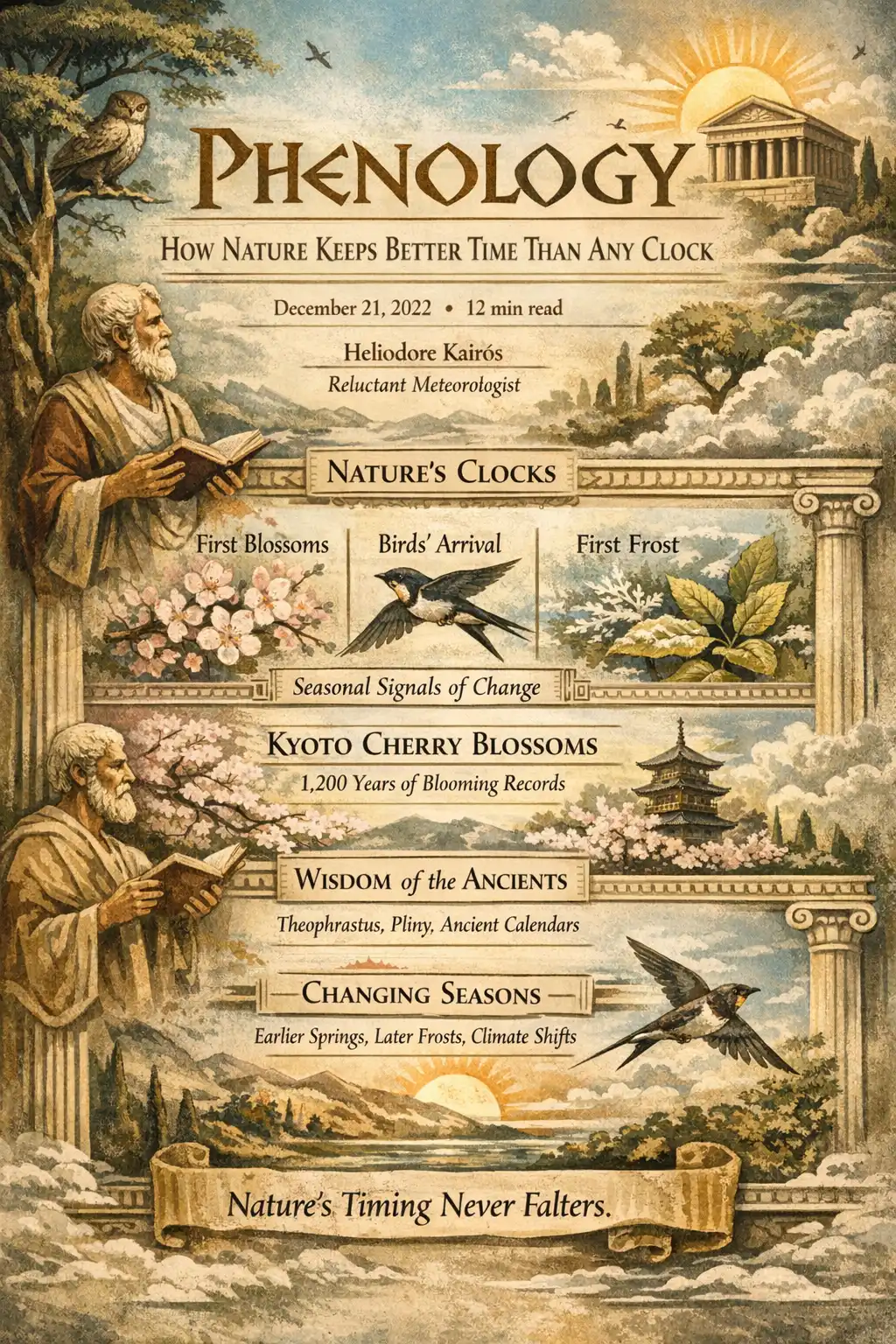
Phenology: How Nature Keeps Better Time Than Any Clock

There is a fig tree behind my house. It is old, possibly older than me, though I would not care to confirm either number. Every spring, without fail, it produces its first leaves within the same five-day window. Not a calendar date chosen by committee, not a notification pushed to a screen, not a forecast hedged with probability percentages and a corporate disclaimer. The tree simply knows. It reads the soil temperature, the photoperiod, the accumulated warmth of the preceding weeks, and it acts. It has done this, I suspect, since before Nikolas Faros was born, and it will continue long after his teleprompter falls silent.
This is phenology. The science of seasonal timing in living things. And if you have never heard the word, do not feel embarrassed. Most people haven't. It is one of those disciplines that hides in plain sight, practiced for millennia by farmers and sailors and grandmothers who could tell you, to the day, when the swallows would return, but which only acquired a proper Greek name in the nineteenth century. Charles Morren, a Belgian botanist, coined the term phainologia in 1849, from the Greek phainein, to show or to appear. The study of appearances. Of things making themselves visible at the appointed time.
I find the whole business immensely satisfying, and also faintly humiliating. Because after forty years of reading thermometers, barometers, and the occasional satellite feed (under duress), I must concede that a migratory warbler navigating from sub-Saharan Africa to my island, arriving within days of the same date each April, is performing a feat of temporal calibration that no instrument on my wrist could match.
What Phenology Actually Measures
Phenology tracks recurring biological events and their relationship to climate. The first bloom of a cherry tree. The arrival date of a migratory bird. The day the ground freezes hard enough that your spade bounces off it. The emergence of the first butterfly of spring. Each of these is a phenological event, and each is triggered by a combination of environmental cues that the organism has evolved to read with extraordinary precision.
The primary drivers are temperature and photoperiod (day length). Most temperate plants track accumulated heat using a metric called Growing Degree Days (GDD): the sum of daily mean temperatures above a base threshold, typically 10 degrees Celsius for most European species. A lilac bush, for instance, does not bloom when the calendar says "April." It blooms when it has accumulated roughly 120 to 150 GDD since the start of the growing season. If March was warm, the lilac blooms early. If March was bitter, it waits. The calendar is irrelevant. The heat budget is everything.
Photoperiod provides the second clock. Many organisms use day length as a coarse seasonal signal, a kind of background calendar that prevents premature responses to freak warm spells in January. A warm week in February will not trick a beech tree into leafing out, because the photoperiod is still short enough to keep dormancy locked. The system is elegant: temperature provides the fine-grained timing, photoperiod provides the safety rail.
Some organisms add a third requirement: vernalisation, a mandatory period of cold exposure. Winter wheat, for example, requires several weeks below 5 degrees Celsius before it can flower. This prevents autumn-germinated plants from attempting to flower before winter, which would be, to use a technical term, catastrophic. The plant demands proof that winter has actually occurred before it commits to reproduction. I find this deeply relatable.
The Kyoto Cherry Blossoms: 1,200 Years of Data
If phenology has a sacred text, it is the cherry blossom record of Kyoto.
Since approximately 812 CE, the blooming date of cherry blossoms (Prunus jamasakura and later Prunus x yedoensis) in Kyoto has been documented in imperial court diaries, poetry collections, and festival records. This is the longest continuous phenological dataset on Earth: over twelve hundred years of a city watching the same trees and writing down what it saw.
The record is extraordinary for several reasons. First, its length. Twelve centuries of observation span the Medieval Warm Period, the Little Ice Age, the Industrial Revolution, and the modern warming era. The data show that the average blooming date in Kyoto has shifted earlier by roughly ten days since the 1850s. In 2021, the cherry blossoms peaked on March 26, the earliest date in the entire 1,200-year record. In medieval times, the typical peak fell in mid-April.
The relationship between blooming date and March mean temperature is remarkably tight. Studies by Yasuyuki Aono and Keiko Kazui at Osaka Prefecture University reconstructed March temperatures from the blossom dates with a correlation coefficient above 0.85. In practical terms, the cherry trees have been functioning as thermometers for over a millennium, recording local climate with a fidelity that puts many early instrumental records to shame.
According to The Weathered Pages, entry dated some April morning in what I believe was 2017, I noted after reading about the Kyoto data: "The Japanese have kept better records with flowers than most nations have kept with mercury. Shameful. Also: beautiful."
The First Frost and the Last Frost
On the other end of the seasonal arc, phenologists track frost dates with similar devotion. The last spring frost and the first autumn frost define the growing season, and their timing determines what can be planted, when it can be harvested, and whether the entire enterprise was worth the trouble.
In the contiguous United States, NOAA maintains frost date records going back to the late nineteenth century. The trend is unambiguous: over the past century, the last spring frost has shifted earlier by roughly two weeks in many regions, while the first autumn frost has shifted later by a similar margin. The net effect is an extension of the growing season by approximately 15 to 25 days across much of the Northern Hemisphere since the 1950s.
In Europe, the Pan European Phenology Database (PEP725) collects records from over 19,000 stations across 32 countries. It tracks events like budburst, flowering, fruiting, and leaf fall for dozens of plant species. The dataset confirms the same pattern: spring is arriving earlier, autumn is departing later, and the biological calendar is stretching toward a longer, warmer active season.
This is not merely an academic observation. Frost dates govern agriculture at a level of practical urgency that no satellite model can replace. A farmer in Burgundy deciding when to prune grapevines, a citrus grower in southern Spain timing irrigation, an olive farmer on my island deciding whether to spread nets early or late: these decisions rest on phenological knowledge, much of it transmitted orally across generations, and all of it under strain as the timing shifts.
Birds Know Things We Don't
Animal phenology is, if anything, even more astonishing than the botanical variety. Migratory birds time their journeys with a precision that borders on the offensive.
The barn swallow (Hirundo rustica) arrives in southern Europe within a remarkably consistent window each spring. Records from the British Trust for Ornithology show that the mean arrival date in the UK has shifted earlier by approximately 8 to 10 days since the 1960s. Similar trends have been documented across the continent.
But here is where it gets complicated. The birds respond primarily to conditions on their wintering grounds and along their migration route, while the insects they feed on at their destination respond to local spring temperatures. If spring advances faster in northern Europe than in the Sahel, a mismatch develops: the birds arrive, but the peak insect abundance has already passed. Ecologists call this "phenological mismatch," and it is one of the more insidious consequences of climate change, a desynchronisation of biological clocks that evolved in concert over millennia.
The pied flycatcher (Ficedula hypoleuca) provides a textbook case. A study by Christiaan Both and colleagues, published in Nature in 2006, showed that populations in the Netherlands had failed to advance their arrival date to match the earlier peak of caterpillar abundance in oak forests. The caterpillars, responding to local temperature, peaked roughly two weeks earlier than they had in the 1980s. The flycatchers, migrating from West Africa and unable to perceive Dutch spring from thousands of kilometres away, arrived at the old time. Breeding success declined. Populations dropped by roughly 90 percent in the most mismatched areas.
As Heraclitus once noted, though in a slightly different context, everything flows. He did not specify that everything flows at the same rate. That distinction, it turns out, matters enormously.
Theophrastus and the Ancients
Phenology as a scientific practice may be modern, but phenological observation is ancient. Theophrastus of Eresos, Aristotle's successor at the Lyceum and the first true botanist, recorded seasonal timing of plants in his Historia Plantarum and De Causis Plantarum around 300 BCE. He noted the relationship between flowering times and local climate, observed that plants in warmer locations bloomed earlier, and catalogued the seasonal habits of Mediterranean species with a care that would satisfy a modern field ecologist.
The Chinese kept phenological calendars from at least the Zhou Dynasty (1046-256 BCE). The Xia Xiao Zheng, one of the oldest known Chinese almanacs, lists seasonal markers tied to natural events: "wild geese arrive," "thunder begins," "peach trees bloom." These were not poetic decorations. They were agricultural instructions encoded in biological observations.
The Romans paid attention too. Pliny the Elder, in his Naturalis Historia, recorded the blooming dates of various plants and connected them to agricultural timing. He noted, for instance, that barley should be sown when the asphodel blooms. This is pure phenological guidance: calibrating human activity to biological clocks rather than calendar dates.
I bring up these ancients not to romanticise the past (although I am not above it), but to make a point. For most of recorded history, phenology was not a science. It was simply how people lived. You did not need a word for it because it was so obvious, so embedded in daily life, that naming it would have seemed absurd. The idea that you might consult an algorithm to determine when to plant your beans, rather than watching the chestnut tree across the road, would have struck Theophrastus as a sign of civilisational decline.
Nikolas Faros, I feel certain, has never observed a chestnut tree in his life.
My Fig Tree, Reconsidered
Let me return to the fig behind my house, because it illustrates something important about phenological precision.
I have recorded its leafing-out date for twenty-three consecutive years in The Weathered Pages. The earliest was March 9. The latest was March 28. The mean falls around March 17, with a standard deviation of roughly five days. Over those twenty-three years, the mean date has crept earlier by approximately four days, which aligns neatly with the regional warming trend of about 0.3 degrees Celsius per decade observed across the eastern Mediterranean.
The tree is not merely tracking temperature. It is integrating soil moisture, root-zone temperature (which lags air temperature by several days), photoperiod, and probably signals I do not fully understand. Perhaps fungal networks in the soil, perhaps chemical cues from neighbouring plants. The result is a decision ("now") that emerges from a computation far more complex than anything Nikolas Faros's studio weather model performs.
And the fig tree does all this without a single sensor, without Wi-Fi, without a software update, and without once crashing at an inopportune moment.
Citizen Science and the Modern Phenological Network
The modern study of phenology has been revolutionised by citizen science. In the United States, the National Phenology Network (USA-NPN) coordinates observations from thousands of volunteers who record the timing of leafing, flowering, and fruiting for standardised species. The programme, called Nature's Notebook, has generated millions of records since its launch in 2007.
In Europe, PEP725 aggregates data from national networks with records stretching back, in some cases, to the 1750s. The German phenological network, maintained by the Deutscher Wetterdienst, has continuous records from the 1950s across hundreds of stations.
These datasets are invaluable for climate science. Because phenological events respond to real, biologically integrated temperature signals rather than single-point thermometer readings, they capture climate change in a way that is both intuitive and scientifically robust. When someone asks, "Is the climate really changing?", the answer is not only in the temperature record. It is in the cherry blossoms blooming two weeks early. It is in the swallows arriving before the fishermen expect them. It is in my fig tree, leafing out four days sooner than it did when I first started watching.
The Reluctant Concession
I should note, with the appropriate degree of distaste, that modern wrist-mounted devices can now track local temperature trends, sunrise and sunset times, and barometric pressure with enough granularity to serve as crude phenological instruments. A GPS watch that logs daily temperature extremes over several weeks can, in principle, calculate something resembling Growing Degree Days. It can flag the lengthening photoperiod. It can note the barometric patterns that precede a late frost.
It will never, of course, match the fig tree. No algorithm will. But I concede, grudgingly, painfully, that having real-time environmental data on your wrist is not entirely without merit for someone who wishes to observe the natural calendar with a degree of rigour. The ancients watched the trees and the birds. A modern observer might watch the trees, the birds, and their wrist, in that order of priority.
Theophrastus would have understood. Nikolas Faros, naturally, would not.