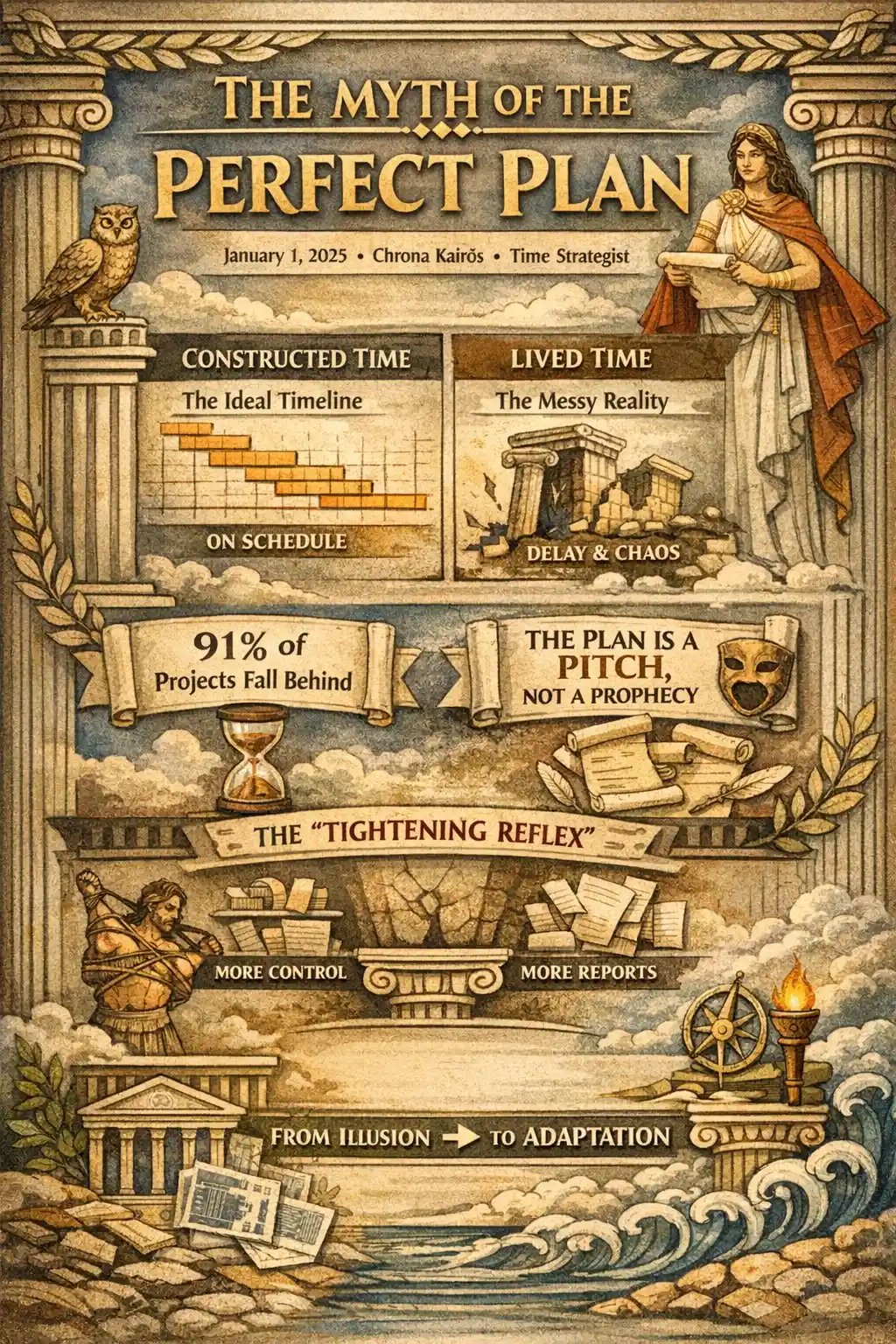
The Myth of the Perfect Plan

I studied architecture. Not buildings, structures. The logic of how constraints become decisions, how decisions become plans, and how plans become things that stand up in the real world.
The first thing they teach you in architecture school is that the blueprint is not the building. The second thing, which takes longer to learn, is that the blueprint was never supposed to be.
I think about this a lot when I watch companies build project plans.

The two times
There's a concept in French sociology (bear with me, I promise this goes somewhere useful) that draws a clean line between two kinds of time. Henri Lefebvre, the philosopher who spent his career studying how people actually live versus how planners imagine they live, called them conceived space and lived space. Swap "space" for "time" and you get something every project manager recognizes but rarely names.
Constructed time is the plan. The Gantt chart. The twelve-month roadmap presented to the board in January, with milestones color-coded and dependencies perfectly aligned. It's clean, logical, and reassuring. It assumes that the future will cooperate.
Lived time is what actually happens. The client who changes scope in March. The key engineer who leaves in May. The vendor delay nobody saw coming. The meeting that was supposed to take thirty minutes and consumed the entire afternoon. Lived time is elastic, messy, and stubbornly indifferent to your spreadsheet.
Bent Flyvbjerg, who has studied over 16,000 projects across 136 countries, puts it bluntly: 91.5% of projects go over budget, over schedule, or both. The average cost overrun is 62%. Only 0.5% of projects finish on budget, on time, AND deliver their promised benefits.
Not 50%. Not 30%. Half a percent.
The Sydney Opera House was budgeted at 7 million Australian dollars. It cost 102 million. It was supposed to take four years. It took fourteen. And this is not an outlier. It's the norm. McKinsey data on megaprojects shows an average cost overrun of 79% and schedule delays of 52%.
The German sociologist Hartmut Rosa adds another layer. He describes what he calls the "shrinking present": the window of time during which past experience reliably predicts the future is getting shorter. Technologies change, markets shift, teams reorganize. A five-year plan made sense when industries moved slowly. Today, a twelve-month roadmap is often outdated before the ink dries. The gap between constructed time and lived time isn't just a management problem. It's accelerating.
So the question isn't "why do projects fail?" The question is: why do we keep pretending the plan was ever going to work?
The plan as performance
Here's the uncomfortable answer: because the plan was never really about predicting the future. It was about something else entirely.
Flyvbjerg identifies two mechanisms. The first is optimism bias, the well-documented human tendency to underestimate costs and overestimate benefits. Daniel Kahneman and Amos Tversky called this the "planning fallacy" in 1979: we focus on the specific project in front of us (the "inside view") instead of looking at how similar projects have actually gone (the "outside view"). We think our project will be different. It won't.
The second mechanism is more interesting and more cynical. Flyvbjerg calls it strategic misrepresentation. In large projects with high stakes, planners don't just accidentally get it wrong. They deliberately present optimistic numbers because that's what gets the project approved. The plan isn't a forecast. It's a pitch. A sales document dressed in the language of engineering precision.
Joana Geraldi and Thomas Lechler published a fascinating analysis of the Gantt chart itself. Their finding: the Gantt chart was never designed for complex projects. It was invented for repetitive factory operations at the peak of Taylorism, where every task was predictable and every minute was measured. Applying it to a software rollout or an organizational transformation is like using a train schedule to navigate open ocean. The tool implies a precision that doesn't exist, and that false precision shapes how managers think, plan, and (crucially) blame.
Eisenhower understood this: "Plans are worthless, but planning is everything." The artifact (the Gantt chart, the roadmap, the 47-slide deck) is unreliable. The process of creating it, the conversations it forces, the assumptions it surfaces, that's where the value lives. But most organizations worship the artifact and skip the conversation.
The tightening reflex
This is where it gets really expensive.
A project slips. The milestone that was supposed to land in April is now looking like June. What does management do?
If you've spent any time in a corporate environment, you already know. They add reporting. They schedule more status meetings. They tighten deadlines. They centralize decisions. They ask for daily updates where weekly ones used to suffice. In extreme cases, they add people.
In 1981, psychologists Staw, Sandelands, and Dutton described this pattern precisely. They called it the threat-rigidity effect: under threat, organizations narrow their information processing, centralize control, and revert to familiar routines. The instinct is to grip harder. The result is that the struggling team, already stretched, now spends half its time reporting on why it's behind instead of doing the work that would get it back on track.
Fred Brooks captured the manpower version of this in 1975: "Adding people to a late software project makes it later." New people need ramp-up time, which diverts existing productive resources. Communication complexity grows with the square of team size. The overhead eats the capacity you thought you were adding.
The pattern is always the same. The plan breaks. The response is to reinforce the plan. More control, more rigidity, more pressure to conform to a timeline that was fictional from the start. Nobody stops to ask whether the plan itself was the problem.
I've watched this happen with clients. The founder who responds to a missed deadline by adding a daily standup on top of the existing standup. The VP who demands a revised Gantt chart (with the same level of fictional detail, just shifted right by six weeks). The team lead who starts micromanaging task assignments because "we need more visibility," which is corporate for "I'm scared and I don't know what else to do."
There's also what Eliyahu Goldratt called the student syndrome: when safety margins are built into task estimates, people procrastinate until the deadline looms, consuming the buffer entirely. So management adds more buffer, which gets consumed the same way, which triggers more tightening, which generates more reporting, which eats more of the time that was supposed to go toward actual work. It's a feedback loop, and every turn of the crank makes the project slower and the team more exhausted.
I recognize the reflex. I used to schedule bathroom breaks in my calendar. The impulse to control time when time is slipping away, I know it intimately. And I know that it doesn't work. It never works.
Progressive granularity
So what does work?
Steve McConnell introduced a concept called the Cone of Uncertainty. At the beginning of a project, your estimates can be off by a factor of four in either direction. That's not incompetence. That's physics. You simply don't have enough information yet to know how long things will take.
The Cone narrows, but only as you make decisions that eliminate variability. Not as time passes. As information arrives. Committing to a detailed twelve-month schedule in January is committing at maximum uncertainty. It's choosing bathroom tiles before you've decided where the building goes.
In architecture, nobody does this. You start with a concept sketch. Then a schematic design. Then design development. Then construction documents. Each phase adds detail because each phase has more information to work with. The idea of producing a full set of construction drawings on day one would be considered insane.
And yet this is exactly what most project plans do. Fully detailed, month by month, task by task, from kickoff to delivery, as if certainty were evenly distributed across the timeline. It isn't. Certainty is front-loaded and it decays fast. The further out you look, the less you know. A plan that doesn't reflect this isn't a plan. It's a decoration.
The alternative is what the PMI calls rolling wave planning: plan the near term in detail, keep the medium term in broad strokes, and leave the long term as directional intent. This isn't Agile jargon (though Agile embodies it). It's been in the PMBOK Guide for decades. Detailed sprints for the next two weeks. Rough milestones for the quarter. Thematic direction for the year.
The critical shift is philosophical, not technical. It means accepting that your plan will be wrong, and designing the plan to accommodate that. It means telling the board: "Here's what we're doing this month. Here's roughly where we expect to be in Q3. And here's the direction for next year, which will change based on what we learn." Some executives find this uncomfortable. They prefer the fictional certainty of a color-coded twelve-month roadmap. That preference is, statistically speaking, the single largest risk factor for project failure.
What I tell teams
When I sit down with a team (usually after something has already gone sideways, because nobody calls a Time Strategist when things are going well), I start with one question. I point at the project plan and ask: what do you actually know?
Not what you've assumed. Not what you've been told to put in the deck. What do you know, right now, with confidence?
Usually the answer covers the next two to four weeks. Everything beyond that is a mixture of hope, precedent, and what someone promised a stakeholder six months ago. That's not a plan. That's a story.
So we rebuild. Detailed tasks for the next sprint. Named milestones for the next quarter, with honest uncertainty ranges. And for everything beyond that, a direction, not a destination. We build in buffers (Goldratt's principle: stop hiding safety margins in individual tasks and aggregate them at the project level). We schedule retrospectives that actually lead to changes, not just venting.
And we have a conversation that most organizations avoid: what are we going to stop pretending we know?
That conversation is the most productive meeting most teams will ever have.
My father, who has never managed a project in his life and would consider the very concept an insult to the natural order, once told me: "The sky doesn't consult a schedule before it rains. It just pays attention to conditions." He was talking about weather, obviously. But he was also, accidentally, describing the best project management philosophy I've ever encountered. Pay attention to conditions. Adjust. Stop arguing with reality.
January 1st
I write this once a year. This year it's for the managers, the project leads, the people who stare at a Gantt chart every Monday morning and feel the gap between the colored bars and reality growing wider.
The plan is not the project. The map is not the territory. And the instinct to grip harder when things slip is the most expensive reflex in business.
Your team doesn't need a more detailed schedule. They need permission to say "we don't know yet" and a structure that treats that honesty as information, not failure.
Time is not a resource to optimize. It's a medium to work within, honestly, with the humility to admit that the future doesn't read your spreadsheets.
Build the plan. Then let it breathe.