The Sun Is Not Subtle: A Reluctant Guide to the UV Index

There is a number on your phone, somewhere between the weather forecast and the pollen count, that most people ignore entirely. It sits there, modest, unassuming, occasionally accompanied by a small sun icon. The number is the UV Index, and it is, I assure you, more important than whatever Nikolas Faros said about Thursday's cloud cover.
Loading calculator...

I have spent forty years on this island watching the sun do what the sun does. It rises, it climbs, it burns the backs of German tourists who fall asleep on the beach at half past eleven, and it sets. The UV Index attempts to quantify one narrow aspect of this ancient, indifferent performance: how quickly the sun's ultraviolet radiation will damage unprotected human skin. A simple enough premise. And yet, like most simple things, it is widely misunderstood.
What the Number Actually Means
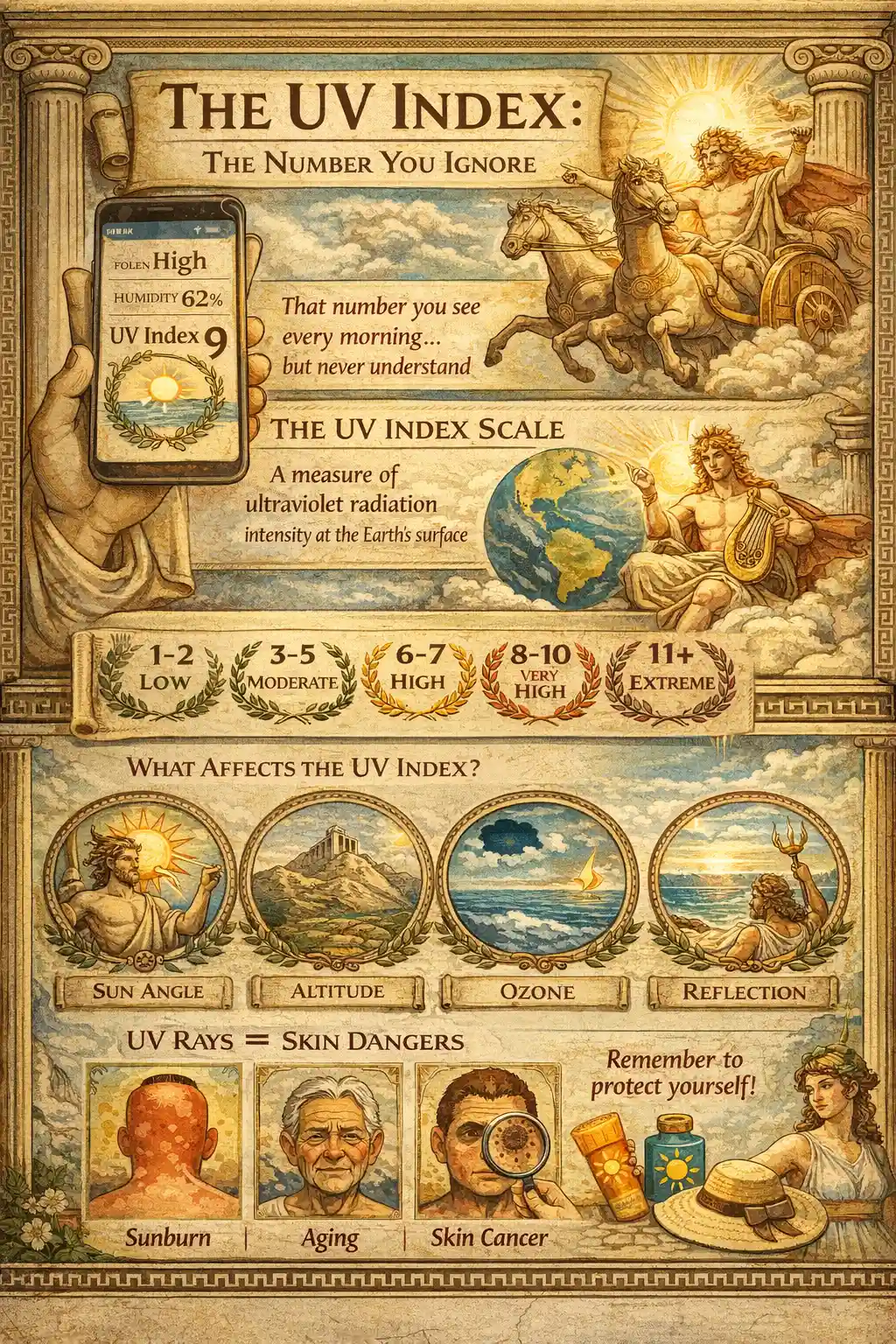
The UV Index is a scale, developed in 1992 by Environment Canada and internationally standardised by the World Health Organization in 1994. It measures the intensity of erythemally weighted ultraviolet radiation at Earth's surface. "Erythemally weighted" is a precise way of saying: adjusted for how effectively each wavelength of UV light causes sunburn.
The scale begins at 0 (nighttime, or a particularly grim November in Helsinki) and has no theoretical upper limit, though values above 11 are classified simply as "extreme." In practice, readings above 16 are rare and confined to high-altitude equatorial locations. The Atacama Desert in Chile, at over 4,000 metres, has recorded values near 20. I find this appropriately biblical.
Each integer on the scale corresponds to 25 milliwatts per square metre of erythemal UV irradiance. A UV Index of 6 means 150 mW/m² of skin-damaging ultraviolet energy is arriving at your location. This is not abstract. At UV Index 6, fair-skinned individuals can expect a sunburn in approximately 15 to 25 minutes of unprotected exposure. At UV Index 10, that window shrinks to under ten minutes.
The WHO groups the scale into five exposure categories:
- 1-2: Low. You will probably survive.
- 3-5: Moderate. Seek shade at midday if you bruise easily.
- 6-7: High. Sunscreen is no longer optional.
- 8-10: Very High. Avoid being outside between 10:00 and 16:00 if possible.
- 11+: Extreme. Stay indoors, or accept the consequences.
On my island, between June and August, we routinely see 9 or 10. Nikolas Faros treats this as an exciting graphic for his broadcast. I treat it as a reason to sit under the fig tree until four o'clock.
The Three Flavours of Ultraviolet
The sun emits electromagnetic radiation across a vast spectrum, from radio waves to gamma rays. The ultraviolet portion sits just beyond violet visible light, between roughly 100 and 400 nanometres in wavelength. It divides into three bands, each with its own personality.
UV-A (315 to 400 nm) comprises about 95% of the ultraviolet radiation that reaches the ground. It penetrates deep into the skin, reaching the dermis. UV-A is responsible for tanning, premature ageing, and contributes to skin cancer risk. It passes through clouds and glass with relative ease, which is why you can get sun damage on an overcast day or through a car window. UV-A intensity remains fairly constant throughout daylight hours.
UV-B (280 to 315 nm) accounts for the remaining 5% but does disproportionate damage. It is the primary cause of sunburn. UV-B is partially absorbed by the ozone layer and varies enormously with the sun's angle, the season, and altitude. The UV Index is predominantly a measure of UV-B intensity, weighted by its biological effectiveness.
UV-C (100 to 280 nm) is the most energetic and most dangerous of the three, but it is absorbed almost entirely by the ozone layer and upper atmosphere. It does not reach the surface under normal conditions. If it did, outdoor life as we know it would be significantly more unpleasant.
The ozone layer, that thin and beleaguered band of O₃ molecules hovering between 15 and 35 kilometres above sea level, is the reason you and I are having this conversation at all. Without it, surface UV-B levels would be roughly fifty times higher. Heraclitus, I suspect, would have found this philosophically interesting. Nikolas Faros would not have mentioned it.
Why Noon Is Not Just Noon
The UV Index peaks at solar noon for a reason that is geometric rather than mystical, though I prefer to think of it as both. When the sun is directly overhead (or as close to overhead as your latitude permits), its light takes the shortest possible path through the atmosphere. Less atmosphere means less absorption, less scattering, and more ultraviolet reaching the ground.
At sunrise and sunset, sunlight enters the atmosphere at a steep angle and must travel through perhaps forty times more air mass than at noon. This additional atmosphere filters out the vast majority of UV-B. By the time the sun sits ten degrees above the horizon, the UV Index is essentially zero.
This is why the old advice to "avoid the midday sun" is not folk wisdom or Mediterranean laziness. It is physics. Between 10:00 and 14:00 local solar time (not clock time, an important distinction Nikolas Faros has never made on air), roughly 60% of the day's total UV dose is delivered. The siesta, that grand Mediterranean institution, is not indulgence. It is radiological prudence.
According to The Weathered Pages, entry dated some Tuesday in late July 2003, I recorded a surface UV Index of 11 at 12:47 local time using nothing more sophisticated than a calibrated sun-sensitive paper strip and a stopwatch. The national meteorological service that day predicted 8. I mention this not to boast, but to observe that ground truth and satellite estimates do not always agree, and that the ground is where your skin happens to be.
Altitude, Latitude, and Other Conspiracies
Several factors conspire to raise or lower the UV Index beyond the simple question of "is the sun high?"
Altitude is perhaps the most underappreciated. UV-B intensity increases by roughly 10 to 12% for every 1,000 metres of elevation gained. At 3,000 metres, you receive about 30 to 36% more UV than at sea level, even if the temperature feels cooler. Mountain hikers burn spectacularly for this reason. The cold air deceives; the sun does not.
Latitude matters because the sun's maximum elevation angle depends on how far you are from the equator. At the tropics, the sun can be directly overhead (UV Index regularly 12+). At 45°N (roughly Lyon, or Minneapolis), the maximum solar elevation in midsummer reaches about 68 degrees, and the UV Index might peak at 8 or 9. At 60°N (Helsinki, Anchorage), even the summer solstice sun only climbs to 53 degrees, and UV Index values above 6 are unusual.
Cloud cover reduces UV, but less than you might think. Thin or broken cloud cover transmits up to 80% of ambient UV. Even under overcast skies, 30 to 50% of UV-B reaches the surface. I have seen tourists on this island, confident in the clouds, turn the colour of boiled lobster by three in the afternoon.
Surface reflection amplifies exposure from below. Fresh snow reflects up to 80% of UV radiation, which is why snow blindness exists and why alpine skiers burn their chins and nostrils. Dry sand reflects about 15%, sea foam roughly 25%, and calm water around 10%. Grass and soil, mercifully, reflect almost nothing.
Ozone variability plays its part too. The ozone layer is not uniform; it fluctuates with weather patterns, latitude, and season. The Antarctic ozone hole, first conclusively documented in 1985 by Farman, Gardiner, and Shanklin of the British Antarctic Survey, demonstrated that human-produced chlorofluorocarbons could thin this shield dramatically. The Montreal Protocol of 1987, one of the rare unambiguous successes of international environmental diplomacy, has allowed the ozone layer to begin recovering. Current projections suggest it will return to 1980 levels by approximately 2066. I find it mildly encouraging that humanity can, when sufficiently frightened, act sensibly.
A Brief History of Burning
Humans have been getting sunburned for as long as we have been human, but the scientific understanding of ultraviolet radiation is surprisingly recent. In 1801, Johann Wilhelm Ritter, a German physicist, discovered ultraviolet light by observing that silver chloride darkened faster when exposed to light beyond the violet end of the visible spectrum. He called it "deoxidizing rays," a name that, while less catchy than "UV," possessed a certain gravitas.
The connection between sunlight and skin damage was established more slowly. By the late 19th century, physicians had noted that outdoor workers developed skin lesions far more frequently than indoor workers. In 1928, the action spectrum of UV radiation on human skin was first measured, establishing that wavelengths around 297 nm were the most effective at causing erythema (sunburn). This is precisely the wavelength range where the UV Index weighting function peaks.
The ancient Greeks, for their part, had a more nuanced relationship with the sun. Heliotherapy (sun exposure for health) was practised in classical Athens. Herodotus noted that the skulls of Egyptian soldiers, who shaved their heads and went bareheaded, were harder than those of their Persian enemies, who wore turbans. He attributed this to sun exposure strengthening the bone. The science is dubious; the observation is magnificent.
On my island, the old fishermen have always known what the UV Index attempts to formalise. They work at dawn and dusk. They rest under stone walls at midday. They wear long sleeves in August. No satellite told them to do this. No index score appeared on their wrists. They simply paid attention, which is an increasingly radical act.
The Measurement Problem
The UV Index as it appears on your weather app is, in most cases, not measured directly. It is modelled. Forecast services like those operated by NOAA, ECMWF, or Météo France calculate expected UV Index values using satellite-derived ozone data, forecast cloud cover, solar zenith angle computations, and surface albedo estimates. The models are good. They are not perfect.
Ground-based UV monitoring stations (using broadband or spectral radiometers) provide direct measurements, but they are sparse. The World Meteorological Organization maintains a network of reference stations, but coverage is uneven, concentrated in Europe, North America, and Australasia. Across much of Africa, Southeast Asia, and the Pacific Islands (where UV exposure is highest), ground monitoring is minimal or absent.
This gap matters because satellite-based ozone measurements, while excellent for large-scale trends, can miss localised variations. A volcanic eruption injecting aerosols into the stratosphere, unusual weather patterns shifting the ozone layer, or simply a broken sensor on one satellite can introduce errors. The UV Index on your phone might be off by a point or two. In the moderate range, this is academic. At the boundary between "high" and "very high," it is the difference between a pleasant afternoon and a week of peeling.
My own method, I freely admit, is not scalable. I step outside. I observe the quality of the light. I note whether my shadow is shorter than I am (UV is high) or longer (UV is declining). I check whether the flagstones on the terrace are too hot for the cat. These are imprecise instruments, but they have the advantage of being present, local, and not dependent on a server in Frankfurt.
What Your Wrist Knows (Grudgingly Acknowledged)
I have resisted acknowledging this for three paragraphs longer than I intended, but I will concede the following: a device on your wrist that displays the current UV Index, derived from your precise GPS coordinates, the date, the time, and ambient light sensor data, is not entirely without merit.
The modern outdoor watch, with its barometric altimeter (correcting for the altitude factor I mentioned) and its real-time solar data, can provide a UV estimate that is, in certain conditions, more locally accurate than the nearest forecast model grid point. This is especially true in mountainous terrain, where elevation changes rapidly and the nearest weather station may be in a valley 2,000 metres below.
I will not say this is superior to forty years of observation. I will say it is faster. And for the tourist who arrives on my island with no Weathered Pages of their own, no instinct for the quality of Mediterranean light, no memory of past burns to guide present behaviour, a number on a screen that says "9" is better than ignorance.
Heraclitus wrote that the sun is new each day. He was speaking metaphysically, but the UV Index agrees in its own pedestrian way: the number changes with every hour, every cloud, every degree of solar elevation. The sun is constant; its effects on your skin are not. Paying attention to the difference, whether through forty years of squinting at the Aegean or through a glance at a wristwatch, is the point.
The sun, after all, does not care whether you are paying attention. It will burn you either way.