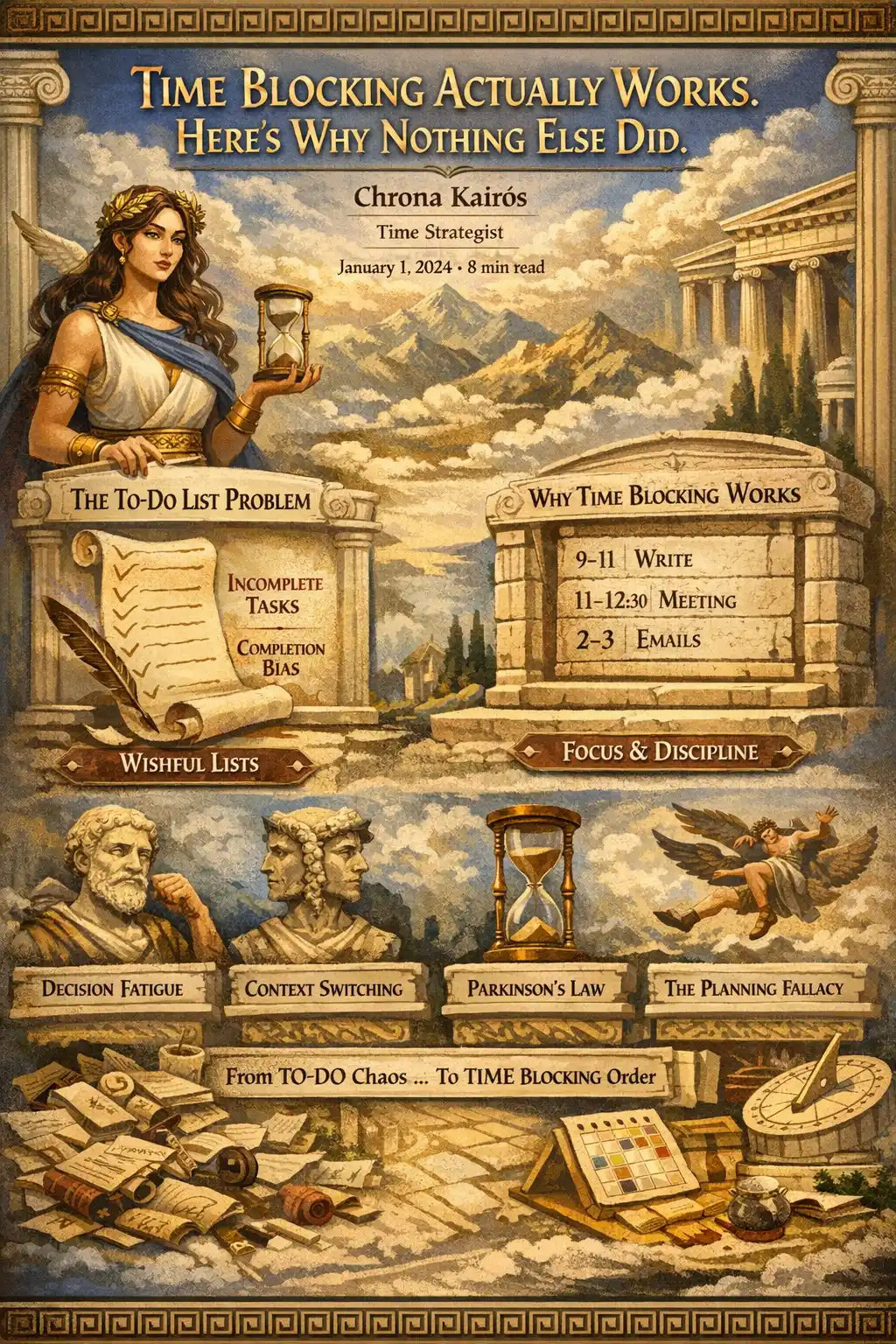
Time Blocking Actually Works. Here's Why Nothing Else Did.

I have tried everything.
To-do lists. Color-coded to-do lists. Apps that gamify to-do lists. Getting Things Done, the full David Allen system, with the inboxes and the contexts and the weekly reviews. Pomodoro timers. Bullet journals. A paper planner with a leather cover that cost more than my first apartment's coffee table.
None of it survived contact with a real workday. Except one thing.

Time blocking is not new. Benjamin Franklin divided his days into six blocks in the 1700s. Cal Newport turned it into a movement with Deep Work in 2016. But the reason it works has nothing to do with who invented it. It works because it's the only method that forces you to answer a question every other system lets you avoid: how many hours do you actually have, and what are you going to do with each one?
The to-do list problem
Let's start with what doesn't work, because you probably have one open right now.
To-do lists are comfortable. They feel productive. You write things down, you check things off, you get a small dopamine hit with each line crossed out. The problem is that a to-do list is a wish list pretending to be a plan. It tells you what needs doing but says nothing about when, or for how long, or whether the twenty-three items on it could physically fit into the hours you have.
Research backs this up. About 41% of to-do list items are never completed. Not because people are lazy, but because lists encourage a specific behavior psychologists call "completion bias": we instinctively pick the quick, easy tasks (reply to that email, rename that file) and leave the hard, important ones sitting there for days. The 3-hour report and the 2-minute reply look identical on a list. They are not identical in reality.
Then there's the Zeigarnik effect: your brain doesn't let go of unfinished tasks. Every unchecked item generates background noise, a low-level anxiety that accumulates throughout the day. Your list isn't just failing to organize your time. It's actively draining the mental energy you need to do the work.
What time blocking actually does
The idea is almost offensively simple. You take your available hours, you divide them into blocks, you assign each block a specific purpose. "9 to 11: write the proposal." "11 to 12:30: code review." "2 to 3: emails and admin." That's it.
The power isn't in the structure. It's in what the structure forces you to confront.
When you sit down with a blank calendar and try to fit your tasks into real hours, something uncomfortable happens. You realize you don't have time for everything. You physically cannot schedule eight hours of deep work, three meetings, lunch, email, and that side project into a single day. The hours don't add up. They never did, but your to-do list let you pretend otherwise.
This is why Cal Newport describes time blocking not as a scheduling technique but as a thinking tool. The plan you produce matters less than the act of producing it. The confrontation with finite time is the feature, not a bug.
Why your brain cooperates
There's real science behind why time blocking works where reactive methods fail.
Decision fatigue. Every time you finish a task and ask "what should I do next?", you spend cognitive resources on a decision. Do that fifty times a day and you've burned significant mental energy before you've produced anything. Time blocking front-loads all those decisions into one planning session, usually ten to fifteen minutes each morning. The rest of the day, you just follow the plan.
Context switching. This is the big one. Research from UC Irvine (Gloria Mark) found that after an interruption, it takes an average of 23 minutes to fully refocus. A 2022 Harvard Business Review study measured the average knowledge worker toggling between apps 1,200 times per day, losing roughly four hours per week just reorienting. That's five working weeks per year, gone. Time blocking reduces switching by keeping you inside one task for an extended period.
Parkinson's law. "Work expands to fill the time available for its completion." Give yourself all day to write a memo and it takes all day. Give yourself a two-hour block and the memo is done in two hours. Not because you rushed, but because the boundary created focus.
The planning fallacy. Kahneman and Tversky identified this in 1979: we systematically underestimate how long things take. Time blocking is the only method that forces a direct confrontation with this bias. You cannot pretend a four-hour project fits into forty-five minutes when you have to physically draw it into your calendar.
How it compares to what you've tried
Pomodoro breaks work into 25-minute sprints with 5-minute breaks. It's an execution tool, excellent for maintaining focus inside a work session. But it says nothing about what you should work on, or when, or for how long. Time blocking is the planning layer. Pomodoro can live inside it. They're complementary, not competing.
GTD (David Allen, 2001) is brilliant at capturing and organizing work. The inbox processing, the contextual lists, the weekly reviews. Where it's weak is scheduling. Allen originally discouraged putting tasks on the calendar unless they had a hard deadline, arguing it would dilute the calendar's reliability. He's since softened that stance. In practice, GTD captures what needs doing. Time blocking decides when it gets done. Again, complementary.
Day theming is time blocking at the macro level. Instead of blocking hours within a day, you dedicate entire days to one type of work. Monday is meetings. Tuesday is writing. Wednesday is admin. Jack Dorsey used this while running Twitter and Square simultaneously. It eliminates daily context-switching between work types. But it requires a level of schedule control that most people simply don't have.
The pattern is clear: time blocking doesn't replace these methods. It fills a gap they all share. None of them answer the question "when, specifically, will I do this?"
Where it breaks
I've watched enough people try time blocking to know exactly how it fails.
Over-scheduling. Blocking every minute with zero slack. One meeting runs ten minutes late and the entire day dominoes. You need buffers. Fifteen to thirty minutes between major blocks. Things run over. You need to eat. Transitions are real.
Ignoring your energy. Scheduling deep cognitive work at 3pm when your brain has been grinding since 8. Or wasting your best morning hours on emails because "I'll just clear my inbox first." Your blocks should follow your energy, not fight it.
Treating the plan as sacred. The plan will break. Every day, something will shift. Newport himself redraws his blocks multiple times per day. That's not failure. That's the system working. The point is intentionality, not perfection.
Never reviewing. Without fifteen minutes at the end of each week to look at what worked and what didn't, the system stagnates. You keep making the same scheduling mistakes. You never learn that you consistently overestimate your capacity on Mondays or that your creative peak is actually at 10am, not 8.
What I actually tell people
When I sit down with a client (usually a founder, sometimes a team, always someone with that glazed look I recognize too well), I don't start with time blocking. I start with the calendar they already have.
I point at an item. Any item. And I ask: why?
Not what it's about. Not who scheduled it. Just, why is this in your life? If they can't answer in one sentence, we remove it. We do this for every item. By the end, the calendar is usually half-empty. That's not a problem. That's the starting point.
Then we build blocks around what's left. The work that matters. The rest that matters too. And enough empty space to handle the fact that life is not a spreadsheet.
The blocks go into Google Calendar. They show up on the wrist. Time. Next block. How long until it ends. No phone to unlock, no notification to pull you sideways. Just the information, and nothing else.
That last part is optional. But I'll say this: the people who check their schedule on their wrist instead of their phone stay inside their blocks longer. Not because the watch has magic powers. Because it doesn't have an inbox.
January 1st
Every year I write about one idea. This year it's this: your time was never the problem. Your relationship with your time was the problem. And the first step to fixing it is embarrassingly simple.
Take tomorrow. Draw some blocks. See what fits.
You'll hate what you discover. That's how you know it's working.