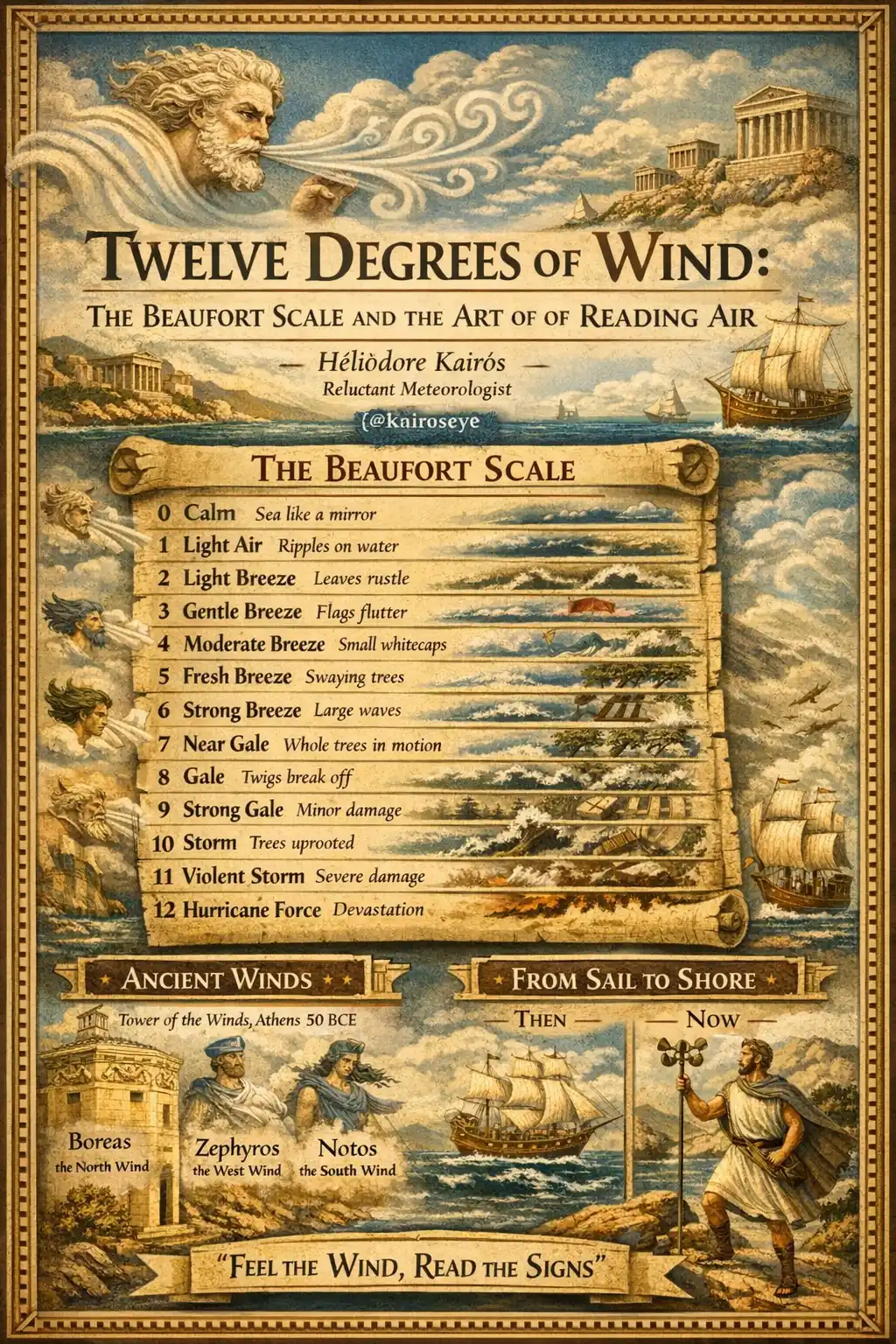
Twelve Degrees of Wind: The Beaufort Scale and the Art of Reading Air

There is a particular silence that precedes wind. Not the absence of sound, exactly, but a quality of waiting, as if the atmosphere itself is holding its breath before deciding what sort of day it intends to inflict upon you. I have spent forty years on this island cataloguing such silences, and I can tell you with absolute certainty that no barometric sensor, no algorithmic forecast, no grinning television personality has ever captured this phenomenon with any accuracy whatsoever.
I will not name names. Nikolas Faros.
Beaufort Scale Converter
Enter a wind speed or tap a force number to see details.
View full Beaufort scale
| Force | Description | km/h | mph | Knots | m/s |
|---|---|---|---|---|---|
| 0 | Calm | 0–2 | 0–1 | 0–1 | 0–0.5 |
| 1 | Light Air | 2–6 | 1–3 | 1–3 | 0.5–1.5 |
| 2 | Light Breeze | 7–11 | 4–7 | 4–6 | 1.6–3.3 |
| 3 | Gentle Breeze | 12–19 | 8–12 | 7–10 | 3.4–5.5 |
| 4 | Moderate Breeze | 20–29 | 13–18 | 11–16 | 5.5–8 |
| 5 | Fresh Breeze | 30–39 | 19–24 | 17–21 | 8–10.8 |
| 6 | Strong Breeze | 40–50 | 25–31 | 22–27 | 10.8–13.9 |
| 7 | Near Gale | 51–61 | 32–38 | 28–33 | 13.9–17.2 |
| 8 | Gale | 62–74 | 39–46 | 34–40 | 17.2–20.8 |
| 9 | Strong Gale | 75–87 | 47–54 | 41–47 | 20.8–24.5 |
| 10 | Storm | 88–102 | 55–63 | 48–55 | 24.5–28.5 |
| 11 | Violent Storm | 103–117 | 64–73 | 56–63 | 28.5–32.7 |
| 12 | Hurricane Force | ≥118 | ≥74 | ≥64 | ≥32.7 |
What is the Beaufort scale?
The Beaufort scale is a system for estimating wind force based on observed conditions at sea or on land. Created by Admiral Francis Beaufort in 1805, it ranges from 0 (calm) to 12 (hurricane force) and remains the international standard for surface wind reporting.
How do I convert wind speed to Beaufort?
Enter a wind speed above and select your unit (km/h, mph, knots, or m/s). The converter will show the corresponding Beaufort force number along with sea and land conditions.
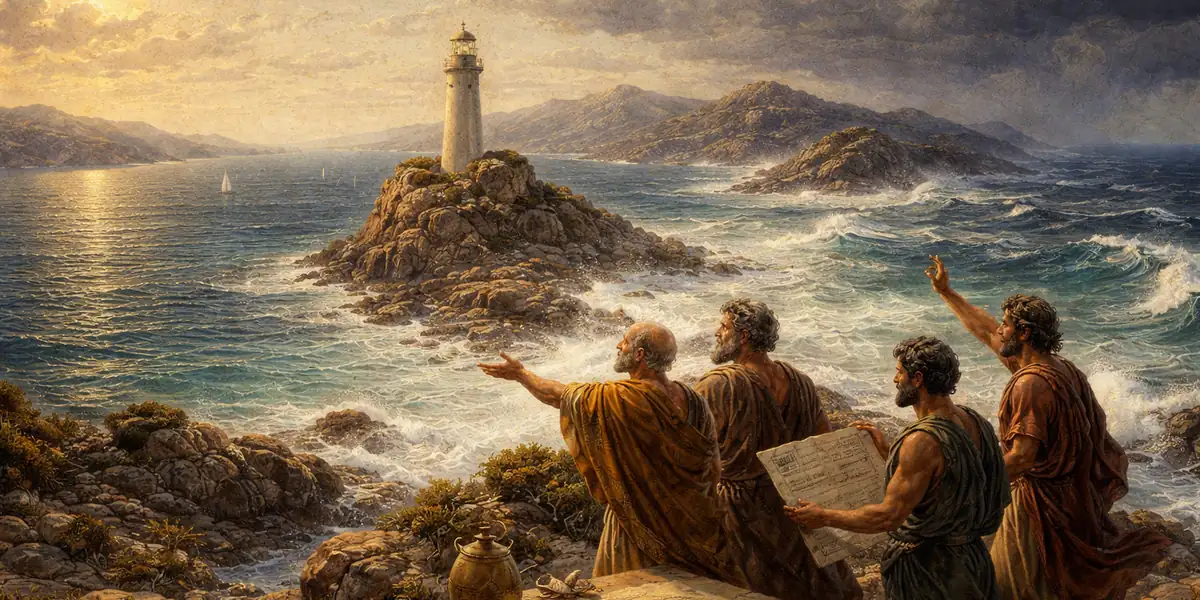
Yet there exists one system of wind measurement that I grudgingly respect. Not because it involves satellites or lithium batteries, but because it was invented by a man who, like myself, simply looked at the sea and wrote down what he saw. His name was Francis Beaufort, and in 1805 he gave the world a vocabulary for something that had, until then, resisted all attempts at precise description.
A Scale Born at Sea
Francis Beaufort was an Irish-born Royal Navy officer with a wound from a pirate attack, a meticulous temperament, and an obsessive need to quantify things. In January 1806, he began using a numerical wind scale in his personal log aboard HMS Woolwich, anchored off the coast of South America. The entries were spare, almost telegraphic. Force 0: calm. Force 6: that which a well-conditioned man-of-war could just carry in chase, full and by. Force 12: that which no canvas could withstand.
Note the elegance of this. Beaufort did not measure wind speed. He had no instrument capable of doing so reliably at sea. Instead, he described the wind's effect on a known object: a fully rigged warship. The scale was empirical, observational, rooted in what a competent sailor could see with his own eyes. No electricity required. No subscription fee.
The original scale ran from 0 to 12, and despite various expansions over the centuries (the World Meteorological Organization added forces 13 through 17 in 1946, though these remain controversial and largely ignored outside of East Asian typhoon forecasting), the core twelve degrees remain the standard. Beaufort himself would have found the extensions unnecessary. Twelve was sufficient. After force 12, you were not measuring wind; you were surviving it.
The Thirteen Faces of Moving Air
Let me walk you through them, because each number on the Beaufort scale is a small portrait of the atmosphere's mood.
Force 0, Calm. Wind speed below 1 knot. The sea is a mirror. Smoke rises vertically. On my terrace, the olive branches hang motionless and the cats sleep without twitching. According to The Weathered Pages, entry dated some Thursday in August, "Force 0. Unbearable. Even the flies have stopped."
Force 1, Light Air. 1 to 3 knots. Smoke drifts lazily, but a wind vane will not budge. Ripples appear on the water, tiny fish-scale patterns without crests. You can feel something on your face if you concentrate, though Nikolas Faros would not notice it in his air-conditioned studio.
Force 2, Light Breeze. 4 to 6 knots. You feel wind on your skin. Small wavelets appear, short and glassy. Leaves rustle. A wind vane begins to move. This is the wind of pleasant afternoons and unconvincing excuses to stay outdoors.
Force 3, Gentle Breeze. 7 to 10 knots. Leaves and small twigs in constant motion. Light flags extend. Large wavelets form on the sea, crests beginning to break. Beaufort's sailors would have noted this as the threshold of useful sailing wind.
Force 4, Moderate Breeze. 11 to 16 knots. Dust and loose paper rise from the ground. Small branches move. The sea shows frequent white horses. This is where things become interesting. At force 4, you begin to understand that wind is not merely air in motion but a force with opinions.
Force 5, Fresh Breeze. 17 to 21 knots. Small trees in leaf begin to sway. Moderate waves on the sea, many white horses. On my island, force 5 is the wind that steals laundry from the line and deposits it in the neighbour's lemon tree. I have lost three shirts this way. I suspect the wind keeps count.
Force 6, Strong Breeze. 22 to 27 knots. Large branches in motion. Umbrellas used with difficulty. The sea forms large waves with extensive white foam crests. Spray begins. Walking into a force 6 wind requires commitment and a certain disregard for dignity.
Force 7, Near Gale. 28 to 33 knots. Whole trees in motion. Inconvenience felt when walking against the wind. The sea heaps up, and white foam from breaking waves is blown in streaks along the direction of the wind. Beaufort's original description for this force referenced the amount of sail a warship would carry: double-reefed topsails and jib. If you do not know what that means, you were born too late, and I am sorry for you.
Force 8, Gale. 34 to 40 knots. Twigs break from trees. Progress on foot is seriously impeded. Moderately high waves with crests breaking into spindrift. At force 8, the distinction between "weather" and "event" begins to collapse.
Force 9, Strong Gale. 41 to 47 knots. Slight structural damage occurs: chimney pots and slates removed. High waves with dense foam streaks. The tumbling of the sea becomes heavy and shock-like. I have experienced force 9 exactly eleven times on this island, and each time I understood, briefly, why the ancient Greeks personified the winds as gods.
Force 10, Storm. 48 to 55 knots. Trees uprooted. Considerable structural damage. Very high waves with overhanging crests. The surface of the sea takes on a white appearance. Visibility is affected by spray. At force 10, The Weathered Pages stay indoors, sealed in their oilcloth pouch.
Force 11, Violent Storm. 56 to 63 knots. Widespread damage. Exceptionally high waves that may obscure small and medium-sized ships. The sea is completely covered with long white patches of foam. This is rare on land, mercifully. At sea, it is the prelude to something worse.
Force 12, Hurricane Force. 64 knots and above. Devastation. The air is filled with foam and spray. The sea is completely white with driving spray. Visibility is very seriously affected. Beaufort's original description was simply: "That which no canvas could withstand." He saw no need to elaborate. Neither do I.
Before Beaufort: Wind as Poetry
The desire to classify wind predates Beaufort by millennia. The ancient Greeks erected the Tower of the Winds in Athens around 50 BCE (though some scholars argue for the second century BCE), an octagonal marble structure with sundials on each face and a bronze Triton weather vane on top. Each of the eight sides depicted a wind god: Boreas from the north, cold and fierce; Notos from the south, bringing rain; Zephyros from the west, gentle and flower-bearing; Apeliotes from the east, with fruits and grain.
The Romans adopted these classifications. Vitruvius, writing in the first century BCE, expanded the system to twelve winds arranged on a compass rose. Medieval sailors refined the system further into the thirty-two-point wind rose that eventually became the compass rose we know today.
But none of these systems quantified the wind's strength. They named its direction, its character, its mythological parentage. A northerly gale and a northerly breeze were both Boreas; the distinction was left to the sailor's judgment and, frequently, his vocabulary of profanity.
Daniel Defoe, after the Great Storm of 1703 that killed perhaps 8,000 people in England and sank thirteen Royal Navy ships, complained bitterly about this imprecision. "The words excessive, terrible, horrible are bandied about with such freedom," he wrote, "that they lose all meaning." He proposed a numerical index but never developed one. It took another century, and a man who had been shot by a pirate off the coast of Turkey, to finish the job.
From Sails to Smoke: The Scale Adapts
Beaufort's original 1806 scale was designed for naval officers aboard square-rigged warships. It described wind force in terms of the sail a frigate could carry. This was immensely practical in 1806 and perfectly useless by 1850, when steam power began replacing sail and the reference object (a fully rigged warship) was becoming extinct.
The scale survived because it adapted. In 1916, George Simpson, director of the British Meteorological Office, extended the Beaufort scale to include land-based observations. His criteria replaced sails with trees, chimney smoke, and the behaviour of pedestrians. Force 2 became "wind felt on face, leaves rustle." Force 9 became "chimney pots and slates removed." The sea state descriptions were formalized separately by the Petersen scale and later integrated.
The World Meteorological Organization officially adopted the Beaufort scale in 1949, assigning specific wind speed ranges to each force number. This was, in a sense, a betrayal of Beaufort's original vision. He had deliberately avoided wind speed because he could not measure it reliably. The genius of his scale was that it required no instruments at all, only a pair of functioning eyes and sufficient sobriety to use them. Attaching precise knot values turned an observational tool into a conversion table.
And yet, the WMO's version is what we use today. Force 7 is 28 to 33 knots, 50 to 61 kilometres per hour, 32 to 38 miles per hour, depending on which unit your particular nation has agreed to pretend is intuitive. The numbers give the illusion of precision. The observation gave the reality of understanding. As Heraclitus once noted, though in a slightly different context, "Eyes are more accurate witnesses than ears." He was talking about sensory knowledge. He might as well have been talking about anemometers.
Why the Scale Still Matters
There is something profoundly satisfying about the Beaufort scale's persistence. In an era of Doppler radar, satellite-derived wind fields, and computational fluid dynamics models running on supercomputers, a system invented by a man with a quill pen and a view of the ocean remains the international standard for surface wind reporting.
Weather stations worldwide report wind observations in Beaufort numbers. Marine forecasts use them. The Shipping Forecast, broadcast by the BBC since 1924 and beloved by insomniacs across the British Isles, speaks in Beaufort: "Viking, North Utsire, South Utsire. Southwest 5 to 7, occasionally gale 8."
The reason is not nostalgia. The Beaufort scale endures because it communicates something that raw numbers cannot: the experience of wind. Telling me the wind is blowing at 43 kilometres per hour conveys data. Telling me it is force 6 conveys a scene. I know what force 6 looks like, sounds like, feels like against my face as I stand on the headland watching the sea turn white. The number carries sensory weight. The kilometres per hour carry only arithmetic.
This is the fundamental tension of modern meteorology, and indeed of modern measurement in general. We have gained precision and lost fluency. We can tell you the wind speed to the nearest tenth of a knot, updated every three seconds, streamed to your wrist via Bluetooth from a sensor array that would have made Beaufort weep with envy. But can you feel force 7 in those numbers? Can you smell the salt in 33.4 knots?
The Winds of My Island
I keep my own wind records, naturally. The Weathered Pages contain forty years of daily observations, each one noted in Beaufort numbers with accompanying remarks that I flatter myself are more evocative than any automated weather station's CSV output.
My island sits in the path of the Meltemi, the fierce northerly wind that rakes the Aegean from June through September. It is a dry wind, cloudless and relentless, born when high pressure over the Balkans meets low pressure over Turkey. The ancient Greeks called it the Etesian wind (from "etos," meaning year, because it returns annually with clockwork regularity). It typically registers force 5 to 7 on the Beaufort scale, occasionally reaching force 8 in the channels between islands where the funnelling effect accelerates the flow.
The Meltemi has shaped the architecture of Aegean islands for centuries. Houses are built low, with thick walls and small windows facing away from the north. Windmills were positioned to catch it. Trees grow permanently bent southward, their branches streaming like flags. Ferries cancel. Tourists complain. Locals shrug and wait.
I have a particular fondness for the Meltemi because it is honest. It announces itself clearly: the sky brightens, the humidity drops, and then the wind arrives with the subtlety of a slammed door. There is no ambiguity. No need for a forecast. Force 6 from the north, and it will blow for three days, or five, or seven, and then it will stop as abruptly as it began.
Nikolas Faros, broadcasting from Athens, invariably describes the Meltemi as "strong northerly winds in the Aegean" and advises viewers to "exercise caution." This is like describing the Sahara as "somewhat dry" and advising visitors to "bring water." The man has never stood on a Cycladic headland at force 7 with his shirt plastered to his chest and his glasses threatening to depart for Crete. If he had, he would use different words. Or, more likely, he would simply not go outside.
A Reluctant Concession
I have written nearly two thousand words in praise of an analog, instrument-free, purely observational system of wind measurement, and I find myself, as always, arriving at an uncomfortable juncture.
Because the truth, which I will admit only here and only under protest, is that modern wind measurement has its uses. A GPS-enabled watch on your wrist cannot feel force 7. It cannot smell the Meltemi or hear the particular whistle of a gale through olive branches. But it can record barometric pressure trends that hint at what the wind will do next. It can log your altitude and tell you whether you are ascending into stronger winds or descending into shelter. It can, if you are the sort of person who cares about such things, display real-time weather data from the nearest station.
These are useful capabilities. I will grant them that. Beaufort would have found them interesting, I think. He was, after all, a man who loved data, provided it was collected with rigour and described with precision.
But the next time the wind picks up, before you glance at your wrist, try this instead: look at the sea. Look at the trees. Feel the air on your face. Estimate the force. Write it down, if you like, in your own weathered pages.
You will be surprised how accurate you are. And you will understand something that no sensor can transmit: wind is not a number. It is an experience. Beaufort knew this. Heraclitus, I suspect, would have agreed, though he would have phrased it more obscurely.
Force 5 on my terrace this morning. The olive branches are swaying. The cats have retreated indoors. My pipe, for once, stays lit.
It will do.