The Annual Absurdity: Why We Still Move the Clocks

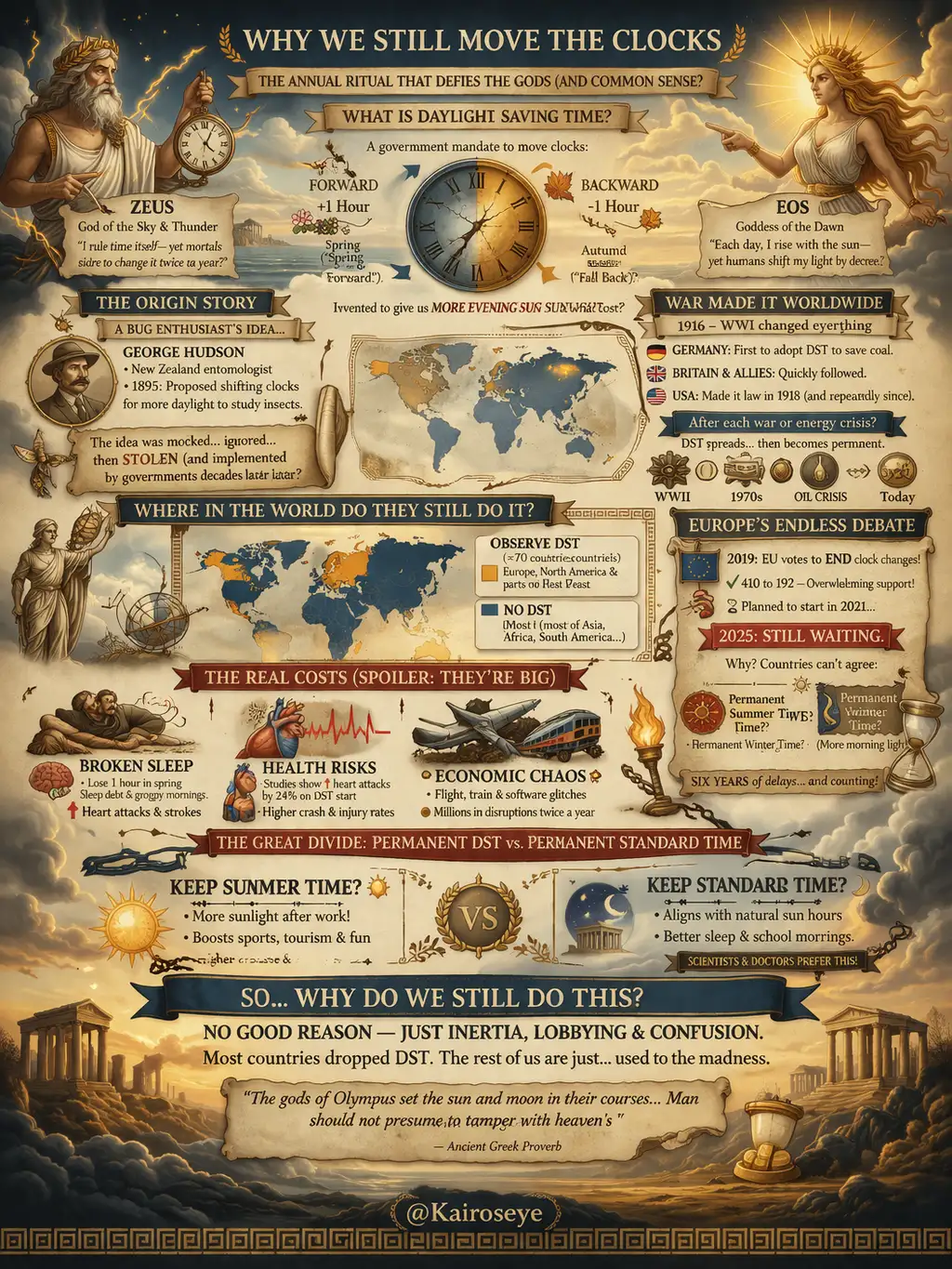
Twice a year, a substantial portion of humanity participates in a collective ritual so bizarre that if you described it to someone who had never heard of it, they would assume you were joking. We move every clock in the house forward one hour in spring, then backward one hour in autumn, and we do this because a New Zealand entomologist wanted more daylight to collect insects.
I am not making this up. I wish I were.

The practice is called daylight saving time, though it saves nothing, least of all my patience. It disrupts sleep, confuses livestock, crashes airline scheduling software, and generates a spike in heart attacks every March that cardiologists have been documenting for two decades. And yet, roughly seventy countries still do it. The rest of the world, sensibly, does not.
The Entomologist and the Satirist
The standard origin story credits George Vernon Hudson, a British-born entomologist living in New Zealand, who in 1895 proposed shifting clocks by two hours during summer so he could have more after-work daylight to hunt for bugs. His paper, presented to the Wellington Philosophical Society, was met with interest and absolutely no action. New Zealand filed the idea somewhere between "eccentric" and "colonial oddity" and moved on.
But Hudson was not the first to have the thought. Benjamin Franklin, while serving as American envoy to Paris in 1784, published an essay in the Journal de Paris suggesting that Parisians could economise on candles by waking earlier. The essay was satirical. Franklin calculated, with mock precision, that Paris could save 64,050,000 pounds of tallow per year if its citizens simply got out of bed when the sun did. He proposed taxing window shutters, rationing candles, and firing cannons at dawn to wake the populace.
It was a joke. Naturally, it was later cited as a serious policy proposal.
The person who actually got the gears turning (pun reluctantly tolerated) was William Willett, a London builder and enthusiastic horseback rider, who in 1907 published a pamphlet titled "The Waste of Daylight." Willett was annoyed that his fellow Londoners slept through perfectly good morning sunshine, and he proposed advancing clocks by eighty minutes during summer, in four incremental steps of twenty minutes each. Parliament considered it. Parliament rejected it. Willett died in 1915, one year before Britain finally adopted a version of his idea.
He never saw it happen. There is something very British about that.
War Makes It Real
Daylight saving time became reality not because of entomologists or pamphleteers but because of war. Germany and Austria-Hungary adopted it on 30 April 1916, hoping to reduce coal consumption for lighting and heating during the First World War. Britain followed on 21 May 1916. The United States joined in 1918. Russia, France, and most of the combatant nations did the same.
The logic was straightforward: shifting the active hours of the civilian population to align more closely with daylight hours would reduce the demand for artificial lighting, thereby conserving fuel for the war effort. Whether it actually achieved this is debatable. The energy savings, if they existed at all, were modest. But the administrative machinery was in place, and governments, having acquired the power to rearrange time itself, proved reluctant to relinquish it.
After the First World War, most countries abandoned the practice. After the Second World War, most adopted it again. After the oil crisis of 1973, yet another wave of adoption followed. The pattern is clear: daylight saving time thrives in periods of energy anxiety and recedes when the anxiety fades. It is a policy born of crisis, sustained by inertia, and defended by people who enjoy barbecuing in the evening.
The Geography of Clock-Moving
As of 2025, approximately seventy countries observe some form of daylight saving time. The vast majority are in Europe and North America. Most of Africa, Asia, and South America do not bother.
The European Union has observed summer time since 1980, harmonising the changeover dates across member states: the last Sunday of March and the last Sunday of October. In 2019, the European Parliament voted overwhelmingly (410 to 192) to abolish the biannual clock change, with the original target of 2021. Each member state would choose to remain permanently on summer time or winter time.
As of early 2026, absolutely nothing has happened. The proposal is stuck in the European Council, where member states cannot agree on which time to keep. The northern countries tend to prefer permanent summer time (more evening light in their brief summers). The southern and western countries lean toward permanent winter time (which aligns more closely with solar noon). Spain, which has been in the wrong time zone since Franco adopted Berlin time in 1940 as a gesture of solidarity with Nazi Germany, has its own uniquely tangled relationship with the clock.
According to The Weathered Pages, entry dated some Wednesday in late October: "Clocks fell back. Lost nothing. Gained an hour of darkness I did not request."
The United States cycles forward on the second Sunday of March and back on the first Sunday of November. The Sunshine Protection Act, which would have made daylight saving time permanent nationwide, passed the Senate unanimously in March 2022 in a moment of rare bipartisan agreement that was, by most accounts, accidental. Several senators later admitted they had not fully understood what they were voting on. The bill died in the House. Subsequent attempts in 2023, 2024, and 2025 have gone nowhere.
Arizona and Hawaii do not observe daylight saving time and seem entirely content with this decision. The Navajo Nation, which spans parts of Arizona, New Mexico, and Utah, does observe it, creating the surreal situation where driving across the reservation requires adjusting your watch, then adjusting it back when you leave, then adjusting it again if you enter the Hopi reservation (which is surrounded by the Navajo Nation but does not observe DST). It is precisely the sort of temporal patchwork that would have given Heraclitus a headache, though he would have appreciated the philosophical implications.
Those Who Quit
The list of countries and territories that have tried daylight saving time and abandoned it is long, growing, and instructive.
Russia abolished DST in 2011, opting for permanent summer time under President Medvedev. Within three years, the population was miserable. Winter mornings were so dark that children walked to school in pitch blackness. In 2014, Russia switched to permanent standard (winter) time instead. The lesson: permanent summer time sounds wonderful until you experience a January sunrise at 10 a.m.
Turkey followed a similar arc. It adopted permanent summer time in 2016, and many residents in the eastern provinces now experience sunrise well after 8 a.m. in winter. The debate continues.
Egypt has abolished and reinstated DST at least seven times since 1988, most recently dropping it in 2014. Brazil ended DST in 2019 after decades of use, citing studies showing negligible energy savings. Argentina experimented with it, abandoned it, tried again, and gave up for good in 2009. Japan used DST during the American occupation from 1948 to 1951, detested it, and has never gone back.
China, despite spanning five geographical time zones, uses a single time zone (Beijing time) and has never adopted daylight saving time. India similarly uses one time zone for the entire subcontinent and does not shift. Iceland, which has extreme daylight variations, stays on GMT year-round and seems unbothered.
The pattern is consistent: countries near the equator see no point in DST (the variation in daylight hours is minimal), and countries that try permanent summer time frequently regret it when winter arrives.
The Health Question
The medical evidence against the biannual clock change has accumulated steadily and is now difficult to dismiss.
A Swedish study published in the New England Journal of Medicine in 2008 found a statistically significant increase in heart attacks during the first three days after the spring transition. The effect was modest (approximately 5% above baseline) but real, and it reversed after the autumn transition, when the extra hour of sleep appeared to be mildly protective.
Sleep researchers have documented measurable disruption to circadian rhythms lasting up to two weeks after the spring shift. The autumn shift is less damaging, though it produces its own oddities: a brief spike in traffic accidents on the first dark evening commute, increased rates of seasonal depression triggered by the abrupt change in evening light.
Nikolas Faros announced last spring, with his usual telegenic confidence, that the clock change is "a minor adjustment that most people adapt to within a day or two." He was, predictably, mistaken. Chronobiologists at Ludwig Maximilian University in Munich have demonstrated that the human circadian system tracks dawn, not the clock, and that the spring shift effectively imposes a form of social jet lag on the entire population. Some individuals never fully adjust before the autumn reversal undoes the whole exercise.
The case for abolishing the biannual shift is, at this point, essentially unanimous among sleep scientists. The debate is not whether to stop changing the clocks, but which time to keep.
Standard Time vs. Summer Time: The Real Fight
This is where the argument gets genuinely interesting, and where reasonable people disagree.
Permanent summer time means more evening daylight year-round. Supporters point to reduced energy use for lighting (debatable), increased outdoor activity (probably true), and economic benefits for retail and leisure industries (plausible). The United States' failed Sunshine Protection Act would have locked the country into permanent DST.
Permanent standard time means the clock stays closer to solar time, where noon actually corresponds, roughly, to the sun's highest point in the sky. This matters more than most people realise. The American Academy of Sleep Medicine, the European Sleep Research Society, and the Society for Research on Biological Rhythms have all issued position statements favouring permanent standard time, arguing that morning light is more important for circadian health than evening light.
The physics are simple. The sun does not care about your preferences. Solar noon, the moment the sun reaches its highest point, is determined by your longitude and nothing else. When you adopt permanent summer time, you push solar noon to approximately 1:30 p.m. by the clock (even later at the western edge of a time zone). Morning light arrives later. Evening light lingers. It sounds pleasant in June. In December, when dawn does not break until well after 9 a.m. in many northern cities, the charm evaporates rapidly.
Spain provides a useful case study. After Franco moved the country to Central European Time in 1940, Spanish solar noon occurs around 1:30 p.m. in winter and 2:30 p.m. in summer. Spain's famous late dinner hour (10 p.m.) and chronic sleep deficit are, according to researchers at the Barcelona Time Use Initiative, partly attributable to living in a time zone misaligned with the sun by sixty to ninety minutes. When Spaniards eat dinner at 10 p.m., they are, by solar time, eating at roughly 8:30, which suddenly sounds much less exotic and much more reasonable.
A Brief Mythology of Stolen Hours
The ancient Greeks, for all their astronomical sophistication, had no need for daylight saving. Their hours were seasonal: the day, from sunrise to sunset, was always divided into twelve equal parts, regardless of the actual duration of daylight. A summer hour was long and languorous. A winter hour was short and cramped. Time stretched and compressed with the seasons, which is, if you think about it, far more honest than pretending a committee can legislate an extra hour of sunlight.
The Romans inherited this system. A Roman hora in midsummer lasted roughly 75 modern minutes; in midwinter, about 45. It was only with the invention of mechanical clocks in the 14th century that Europe committed to the tyranny of equal hours, fixed and unyielding regardless of what the sun was doing. Daylight saving time is, in a sense, a feeble modern attempt to recapture something the ancients understood instinctively: that human time and solar time are not the same thing, and forcing them into alignment requires either wisdom or foolishness.
I suspect we have chosen foolishness. Heraclitus, who observed that you cannot step into the same river twice, would presumably have noted that you cannot step into the same hour twice either, especially if your government has moved it.
The Reluctant Admission
I write this in March, three days after the clocks on this island lurched forward. My body knows it is 6 a.m. My kitchen clock insists it is 7. The coffee tastes the same at either hour, but the principle offends me.
And yet. I will concede, as I must at the end of these dispatches, that there exists on my wrist a small device (I will not call it a watch, because that would dignify it) that adjusted itself automatically at 3 a.m. on Sunday, silently, without complaint, syncing with some satellite or another. It now displays the correct civil time, the correct sunrise, the correct sunset, all updated to the new regime. It did this without asking my permission or my opinion, which is, I suppose, the defining characteristic of technology.
The Weathered Pages, by contrast, required me to cross out "sunrise 06:47" and write "sunrise 07:47" with my own hand, which took thirty seconds and a certain amount of grumbling. The device on my wrist took zero seconds. I am not saying the device is better. I am saying it is faster, which is a different thing entirely.
Somewhere in Athens, Nikolas Faros is adjusting his studio clock and explaining the spring transition to viewers who already understand it. His smile has not changed with the hour. Some things, regrettably, are constant.
Force 3 this morning. The olive branches are stirring. The cats, who do not observe daylight saving time and never will, are asleep in a patch of sun that has shifted, as it always does, by exactly one hour.
It will not do. But we endure it.