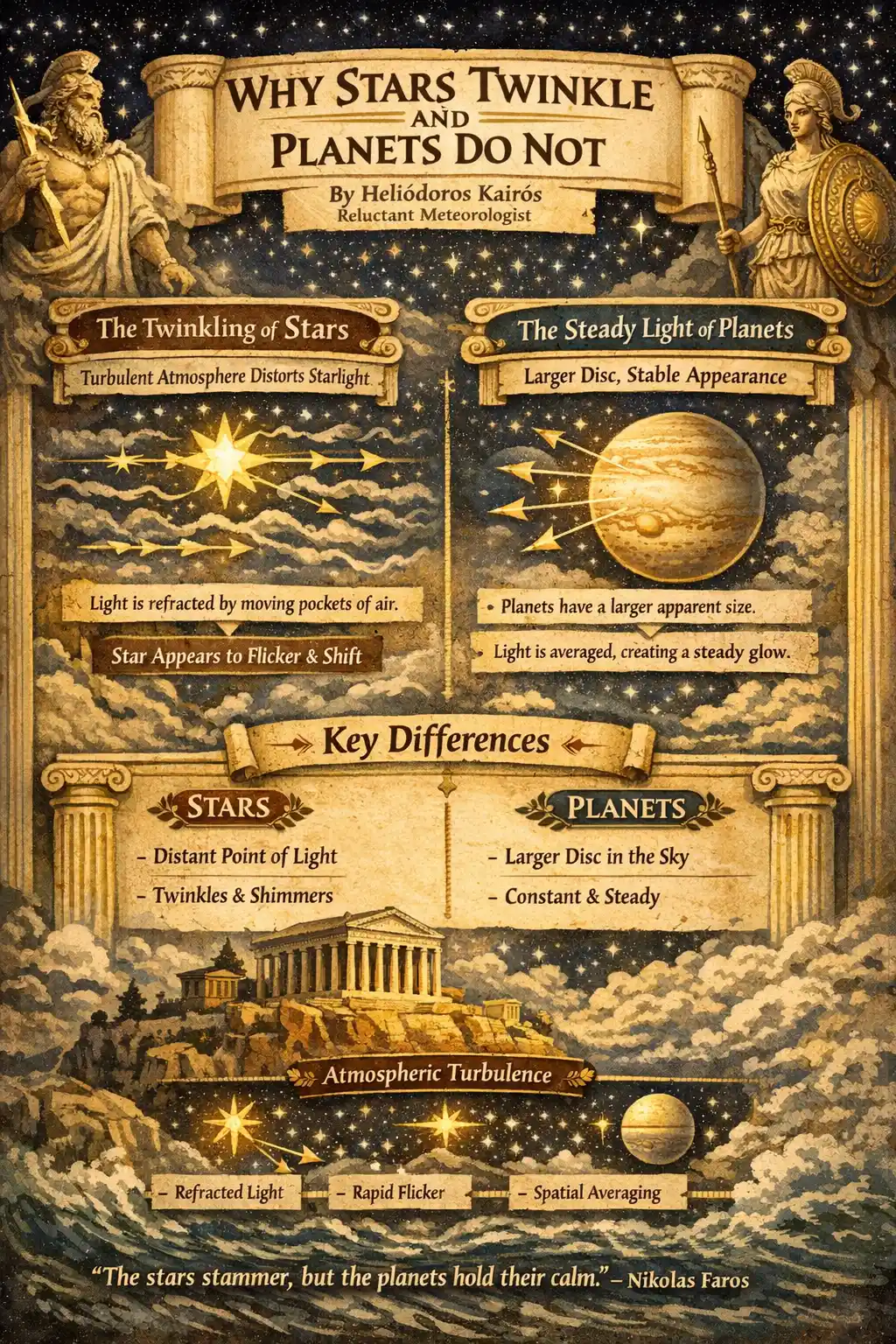
Why Stars Twinkle and Planets Do Not

There is a question that children ask and adults forget to. Why do stars twinkle? It is, on its surface, a simple thing. You look up, you see it: a star pulses, shivers, flickers like a candle flame behind old glass. The planet next to it, however, sits there fat and steady, smugly unperturbed. Same sky, same night, same pair of eyes. And yet one trembles while the other does not.
I have been asked this question perhaps two hundred times. By students, by fishermen, by a taxi driver in Thessaloniki who was, I suspect, making conversation to avoid discussing his route. Each time I answer it, I am struck by the same thought: this is one of those rare phenomena where the explanation is more beautiful than the mystery. The twinkling of a star is not a property of the star at all. It is a portrait of the atmosphere, painted in real time, by light that has travelled for centuries only to be jostled in the last millisecond of its journey.
Nikolas Faros, for the record, once described twinkling on air as "the stars saying goodnight." My pipe nearly set fire to The Weathered Pages.
What Scintillation Actually Is
The technical term is astronomical scintillation, and it refers to the rapid fluctuations in brightness and apparent position of a celestial point source when observed through a planetary atmosphere. The word comes from the Latin scintillare, to sparkle, which is apt enough, though I prefer the Greek notion: the sky stammering.
Here is what happens. Starlight enters Earth's atmosphere as a nearly perfect plane wave. The star is so far away (the nearest, Proxima Centauri, sits at 4.24 light-years) that by the time its light reaches us, the wavefront is essentially flat. Think of it as a perfectly smooth sheet of light arriving from an inconceivable distance.
But our atmosphere is not smooth. It is a turbulent, layered, thermally chaotic mess of nitrogen, oxygen, water vapour, and the occasional misguided weather balloon. Different pockets of air sit at different temperatures, and temperature determines density, and density determines refractive index. A pocket of warm air bends light slightly differently than a pocket of cool air. The difference is tiny, on the order of a few ten-thousandths in refractive index, but it is enough.
As the plane wave passes through these pockets, it gets distorted. Different parts of the wavefront speed up or slow down by fractional amounts, creating small variations in phase. By the time the light reaches your eye, the once-flat wavefront has become corrugated, wrinkled, bent into a chaotic interference pattern. Some parts reinforce each other (the star brightens), some cancel (the star dims). The pockets of air are moving, driven by wind and convection, so the pattern shifts constantly. The star flickers.
The entire process unfolds on timescales of roughly 5 to 20 milliseconds. Your eye, which integrates light over about 50 milliseconds, perceives this as a rapid, irregular twinkling.
The Numbers Behind the Shimmer
The strength of scintillation depends on several measurable factors, and I confess a certain satisfaction in listing them, because they turn a poetic phenomenon into something gratifyingly precise.
Zenith angle. A star near the horizon twinkles far more violently than one overhead. The reason is geometry: light from a star at the horizon passes through roughly 38 times more atmosphere than light from a star at the zenith. More atmosphere means more turbulent pockets, more refractive distortion, more scintillation. This is why stars near the horizon also appear to flash in colours, red and blue and green, because the prismatic dispersion of the atmosphere separates wavelengths, and turbulence makes each colour flicker independently. It is, I admit grudgingly, rather spectacular.
Altitude of the turbulent layer. Most of the relevant turbulence occurs in discrete layers, typically between 5 and 15 kilometres altitude, in the tropopause region where the jet stream lives. The precise altitude matters because it determines the size of the turbulent "cells" projected onto the ground. A turbulent layer at 10 km altitude with cells of 10 cm diameter projects shadows and bright patches about 10 cm across at ground level. Your eye's pupil, at roughly 7 mm in darkness, samples only a small fraction of this pattern. This is critical. Remember it.
Fried parameter (r₀). Named after the American astronomer David Fried, this parameter describes the effective diameter of a coherent patch of atmosphere. In good seeing conditions (at a professional observatory site like Mauna Kea), r₀ might reach 20 cm. In mediocre conditions, say from my terrace when the meltemi is blowing, it might drop to 5 cm. When r₀ is larger than your telescope's aperture, scintillation dominates. When it is smaller, the image blurs but the twinkling actually decreases, because you are averaging over multiple cells.
Wavelength. Scintillation is slightly stronger at shorter wavelengths. Blue light scintillates more than red. This is why twinkling stars sometimes appear to shift colour: the blue and red components of their light are being distorted along slightly different paths.
So Why Don't Planets Twinkle?
And here we arrive at the crux. If the atmosphere is responsible for twinkling, and planets sit under the same atmosphere as stars, why do planets remain steady?
The answer is angular size.
A star, no matter how enormous it actually is, appears as a point source. Even through the largest telescopes, stars are unresolved points of light. Sirius, which is 1.7 times the diameter of the Sun, subtends an angular diameter of about 0.006 arcseconds as seen from Earth. That is roughly the apparent size of a one-euro coin viewed from 700 kilometres away. Your eye cannot resolve this. It is, for all optical purposes, a dimensionless dot.
A planet, on the other hand, presents a disc. Jupiter, at opposition, subtends about 47 arcseconds. Venus can reach 66 arcseconds. Even Mars, smaller and more distant, manages 25 arcseconds at its closest. These are still tiny, invisible to the naked eye as true discs (your eye's resolution limit is roughly 60 arcseconds), but they are vastly larger than a star's apparent size.
Here is why this matters. Each point on the planet's disc acts as an independent source of light. Each of these points scintillates, yes, but they scintillate independently of each other, because they pass through slightly different columns of atmosphere. When your eye collects light from the entire disc, the random brightenings and dimmings from different points average out. One part of Jupiter's disc might dim at the exact moment another part brightens. The net effect: a steady, unwavering light.
The technical term is "spatial averaging," and it is the same reason that a large bonfire does not flicker as much as a candle when seen from a distance. More emitting area means more independent scintillation cells contributing to the total signal, and random fluctuations cancel.
This also explains a subtlety that I find deeply satisfying: planets can twinkle. When a planet is very low on the horizon, the atmospheric path is so long and so turbulent that even the disc's averaging cannot fully compensate. I have seen Venus twinkle on a winter evening when it sat just five degrees above the Aegean. According to The Weathered Pages, entry dated some February in what I believe was 2019, I noted: "Venus stammering at the horizon. Unusual. Atmosphere in poor temper." The conditions must have been particularly turbulent, r₀ dropping below 3 cm, for even Venus's generous disc to fail at smoothing things out.
What Twinkling Tells You About the Air
Here is what I find most remarkable, and what elevates twinkling from a pretty curiosity to a genuine diagnostic tool. The character of a star's twinkling encodes information about the atmosphere it has passed through.
Professional astronomers measure "seeing" in arcseconds: the full width at half maximum (FWHM) of a star's image blurred by the atmosphere. A seeing of 1 arcsecond is good. Below 0.5 arcseconds is exceptional, the domain of sites like Cerro Paranal in Chile (home of ESO's Very Large Telescope) or Mauna Kea in Hawaii. Above 3 arcseconds, you might as well observe through a shower curtain.
Scintillation measurements can reveal the altitude and intensity of turbulent layers. The SCIDAR technique (SCIntillation Detection And Ranging) uses a telescope to observe a binary star and analyses the cross-correlation of scintillation patterns to reconstruct the vertical turbulence profile of the atmosphere. It is, in essence, atmospheric tomography performed with starlight. Elegant, no?
For the amateur observer, without a SCIDAR instrument or indeed any instrument beyond one's own retinae, twinkling still provides useful information. Stars twinkling vigorously and chromatically (flashing colours) near the zenith indicate strong high-altitude turbulence, likely jet stream activity. Stars twinkling only near the horizon suggest calm upper atmosphere with normal low-altitude boundary layer turbulence. And a night where nothing twinkles, where every star sits rock-steady, is a night of exceptional atmospheric stability, rare and precious, the kind of night that makes you want to drag out a telescope and never sleep.
A Brief History of Noticing
Humans have noted the twinkling of stars for as long as they have looked up, which is to say forever. The oldest known written reference appears in the Almagest of Claudius Ptolemy (circa 150 CE), who distinguished between the "trembling" light of stars and the steady glow of planets. Ptolemy attributed the difference to the nature of the celestial bodies themselves rather than the atmosphere, which is forgivable given that the concept of atmospheric refraction would not be properly understood for another fifteen centuries.
Isaac Newton, in his Opticks (1704), came closer. He noted that stars twinkle more near the horizon and speculated that "the Air through which we look upon the Stars, is in a perpetual Tremor." Newton proposed, correctly, that this tremor was caused by thermal variations in the atmosphere. He also noted that planets, being nearer and subtending larger angles, would be less affected. Newton, in other words, had the whole thing essentially right three centuries ago, which should humble any of us who think we have noticed something original about the night sky.
Heraclitus, I suspect, would have had something to say about the matter. "All things flow," he wrote, or is alleged to have written (the fragments are contested, much like Nikolas Faros's weather forecasts). The atmosphere certainly flows, and the twinkling of stars is nothing more than the visible proof of that flow, the sky's own confession that it is never, for even a moment, still.
The Telescope Problem
Every amateur astronomer who has pointed a telescope at a star on a turbulent night knows the frustration. The star, which to the naked eye twinkled charmingly, now boils and writhes in the eyepiece, a seething blob of light that refuses to resolve into the clean Airy disc that optics textbooks promise. This is the same scintillation, magnified and made inescapable.
Interestingly, larger telescopes suffer less from scintillation (because their larger apertures average over more turbulent cells) but more from seeing blur (because their theoretical resolution exceeds what the atmosphere allows). A 20 cm amateur telescope has a theoretical resolution of about 0.6 arcseconds, but the atmosphere typically limits it to 2 or 3 arcseconds. The 8.2-metre primary mirror of ESO's VLT has a theoretical resolution of 0.015 arcseconds, but without adaptive optics, the atmosphere limits it to the same 0.5 to 1 arcsecond as any backyard instrument. The tyranny of the atmosphere is democratic in its oppression.
Adaptive optics, which deforms a flexible mirror hundreds of times per second to counteract atmospheric distortion in real time, has largely solved this problem for professional telescopes. The technique uses either a bright natural star or an artificial laser guide star (a spot of glowing sodium atoms excited at 90 km altitude) as a reference point, measuring the wavefront distortion and correcting it on the fly. The result: images that approach the theoretical diffraction limit. The atmosphere, for the first time in the history of ground-based astronomy, has been neutralised.
I have mixed feelings about this. On one hand, the images are undeniably magnificent. On the other, there was something honest about atmospheric seeing, a reminder that we observe the universe through a veil, that our view is always mediated, always imperfect. Adaptive optics removes the veil, and while the clarity is welcome, I cannot help but feel that something has been lost. The telescope no longer tells you about the atmosphere. It has been taught to ignore it.
The Naked Eye and the Wristwatch
I should, at this point, acknowledge that certain modern devices can provide atmospheric data with a precision that my eyes and The Weathered Pages cannot match. Humidity, barometric pressure, temperature gradients: these are now available on a screen the size of a postage stamp, strapped to the wrist of someone who may or may not be looking at the sky at all.
A GPS outdoor watch like KairosEye will tell you the barometric pressure trend, which correlates with atmospheric stability, which in turn predicts the quality of the seeing. It will tell you the temperature, the altitude, the humidity. Cross-referenced with a weather forecast (not one delivered by Nikolas Faros, who once predicted clear skies during an actual thunderstorm), these data points can help you decide whether tonight is a good night to observe.
I will concede, reluctantly and with my pipe firmly clenched, that this is useful. The atmosphere is, as Newton and Heraclitus both understood, in perpetual tremor. Knowing the character of that tremor before you set up your telescope, or before you simply sit on a headland and look up, is not nothing.
But I will also say this: no wristwatch will teach you what the twinkling of Arcturus looks like on a night when the jet stream is overhead. No barometric sensor will show you Venus stammering at the horizon in February. These things require eyes, patience, and a willingness to sit in the cold for longer than is sensible.
The stars will continue to twinkle. The planets will continue not to. And somewhere in that difference lies a lesson about light, air, distance, and the irreducible value of simply paying attention.