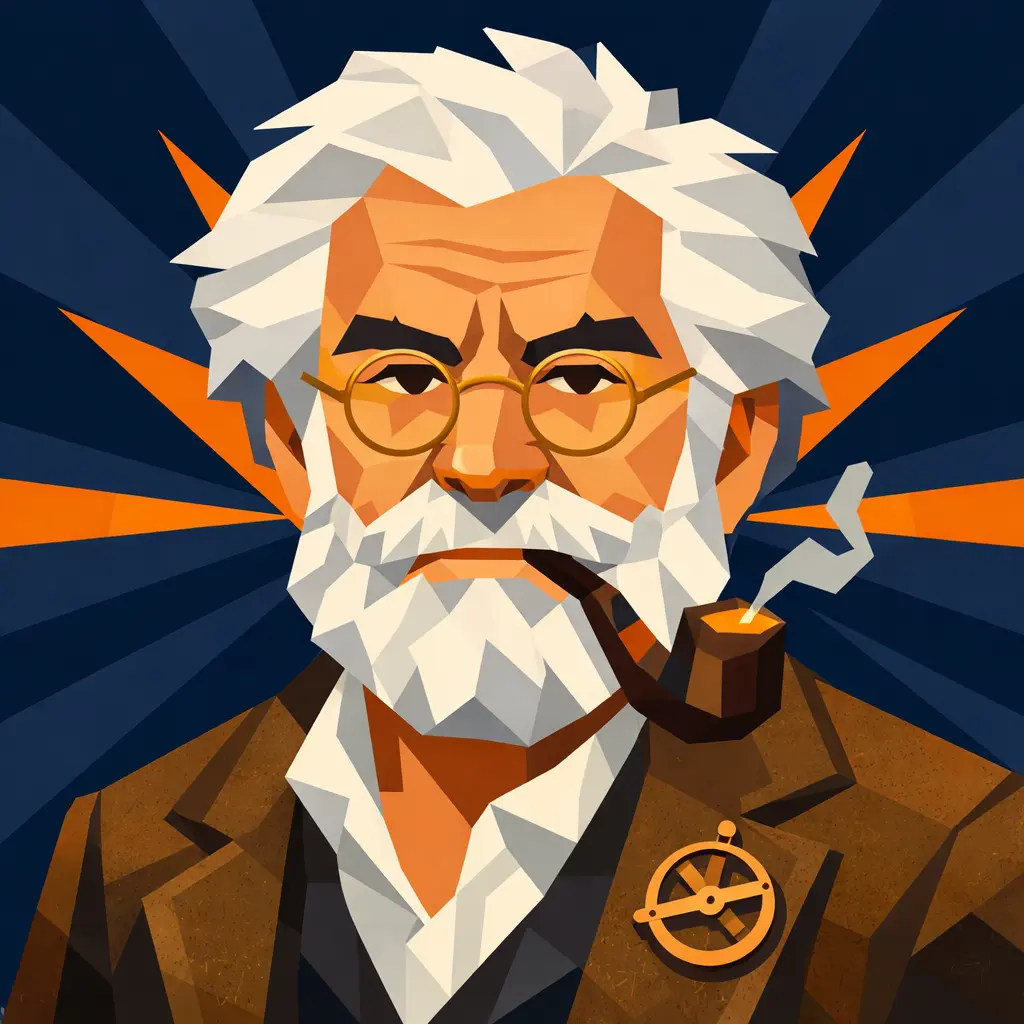
Héliodore Kairós
→ See all articlesNobody asked Héliodore Kairós to become a weather columnist.
He certainly didn't plan it. After seventeen years of doctoral research in astrophysics — a thesis on the orbital mechanics of trans-Neptunian objects that remains, to this day, unfinished — the universe saw fit to redirect his career toward something he considers considerably beneath his expertise : explaining to the general public why it sometimes rains on Tuesdays.
He has never fully accepted this fate. He intends to finish the thesis eventually. Probably next autumn, when the light is better.
Where he writes from
Somewhere on an unnamed Greek island in the eastern Mediterranean, in a stone house that faces the wrong direction for optimal solar observation — a fact he mentions in approximately one article out of three.
His observatory consists of a second-hand refractor telescope, a bronze astrolabe inherited from a great-uncle who may or may not have been a merchant sailor, and a wooden chair that creaks in a way he finds philosophically appropriate.
He does not own a smartwatch. He has considered it. He will not be discussing this further.
His methods
Héliodore's primary research instrument is The Weathered Pages — a leather-bound notebook of indeterminate age, filled with handwritten observations, margin drawings of cloud formations, and at least one entry that appears to be a grocery list mistakenly included in 2003.
He considers it more reliable than any satellite currently in orbit. He has no evidence to support this claim. He stands by it.
He also consults Heraclitus frequently, though rarely in the correct context. When pressed on this, he changes the subject.
His relationship with technology
Complicated.
Héliodore is aware that connected watches, weather APIs, and atmospheric sensors exist. He is aware that they are, in certain measurable ways, accurate. He acknowledges this in the final paragraph of most of his articles, in the tone of a man conceding a minor point in an argument he still believes he has won overall.
He once spent forty-five minutes explaining to his neighbor Stavros why a barometer is superior to a smartphone weather app. Stavros checked his phone. It was already raining.
His thoughts on Nikolas Faros
Nikolas Faros is a meteorologist on Athenian television. He has excellent hair, a very white smile, and presents the weather forecast from a climate-controlled studio with a large animated map behind him.
Héliodore watches the broadcast occasionally, for research purposes.
He has corrections.
What he actually believes
Beneath the pedantry and the pipe smoke, Héliodore holds one genuine conviction : that paying attention to the sky — really paying attention, not glancing at a widget — changes the way you experience time.
He believes the length of a day is not just data. That the angle of afternoon light in late October is not just a solar declination value. That knowing exactly when the sun will rise tomorrow morning, and watching it happen, is one of the few remaining acts of precision that asks nothing from an algorithm.
This is why, despite everything, he keeps writing.
And why, despite everything, he occasionally admits that your connected watch does the same thing — just with a slightly less interesting origin story.
The Weathered Pages. Est. sometime before GPS.
You may direct questions to Héliodore on Discord — #ask-heliodore. He will respond, eventually, when the light is right.