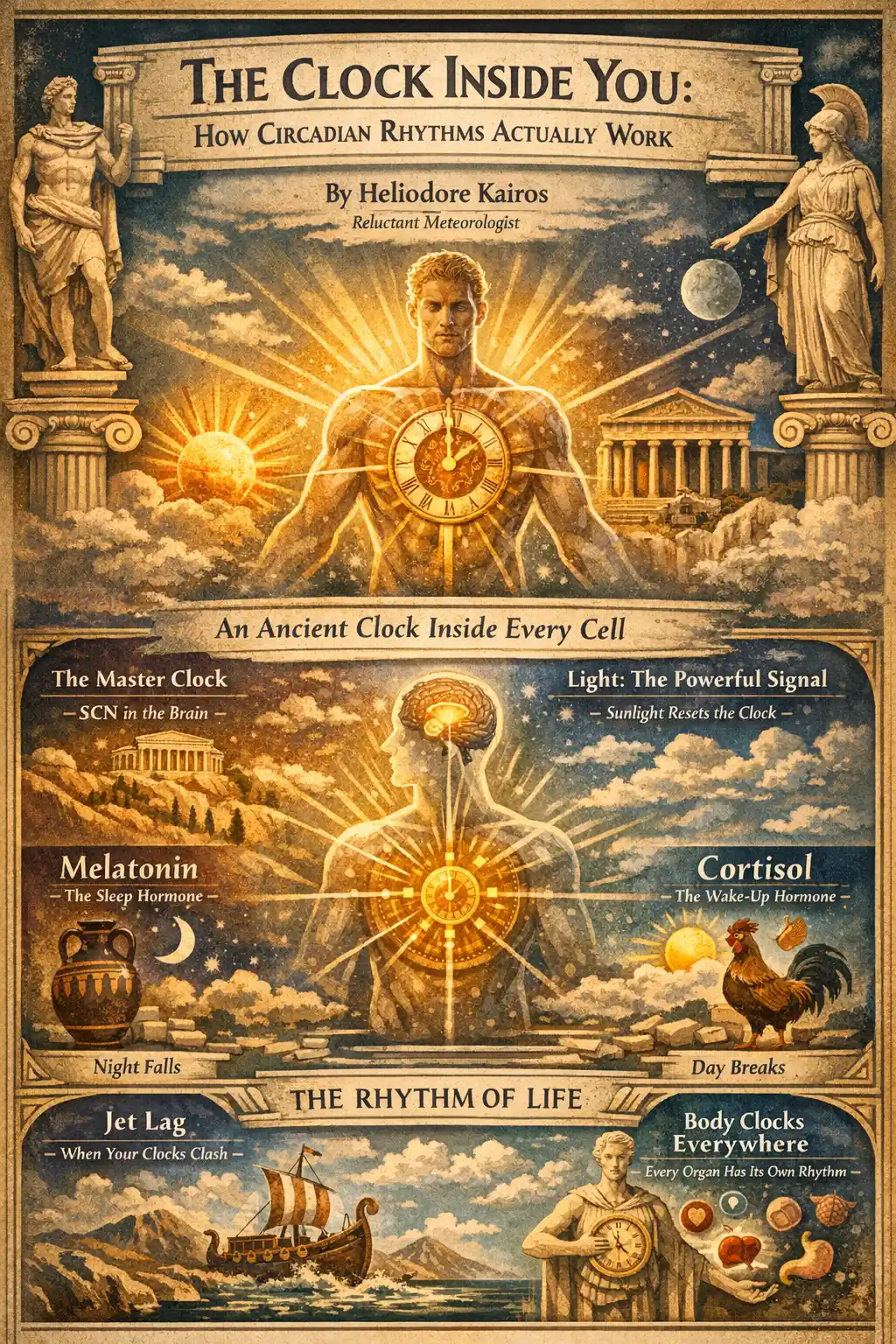
The Clock Inside You: How Circadian Rhythms Actually Work
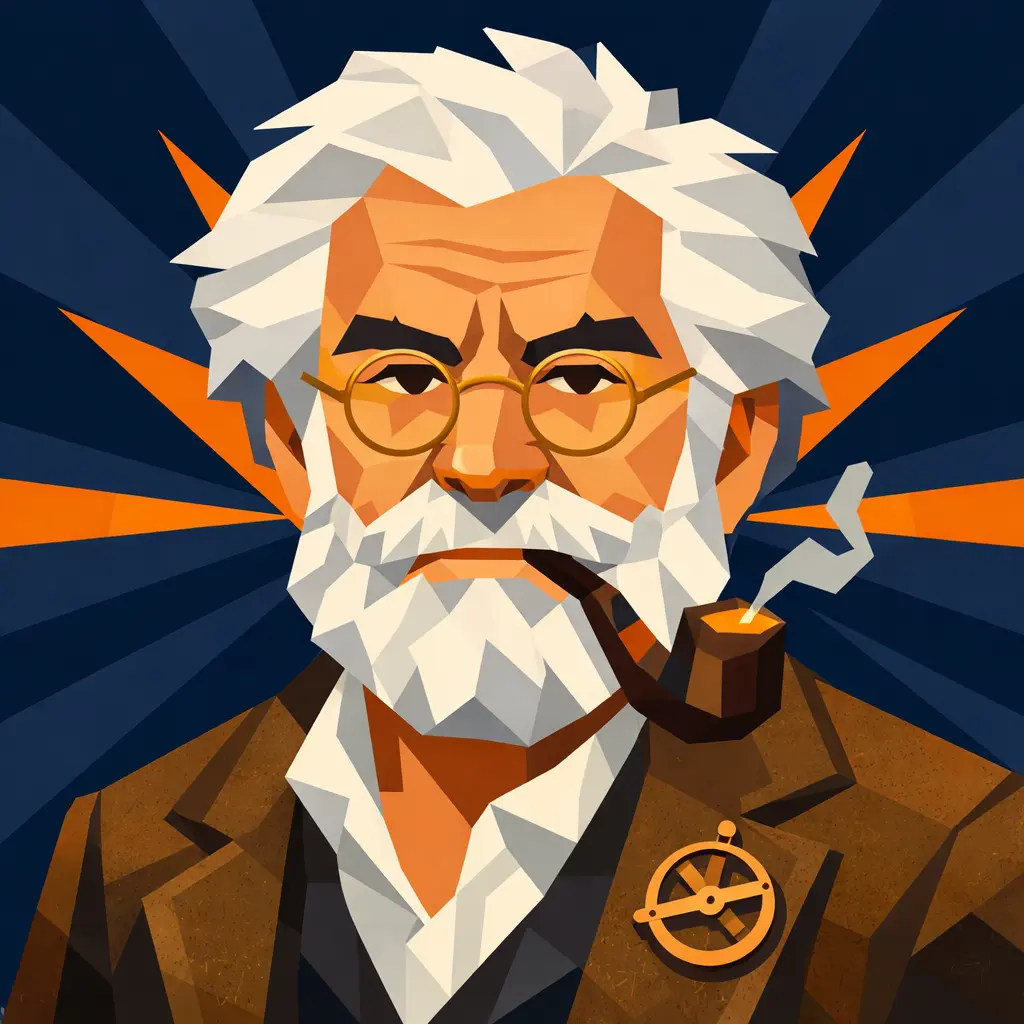
I have spent forty years watching the sun rise over the Aegean, and in that time I have learned precisely two things with absolute certainty. First: the sun does not care about your alarm clock. Second: neither does your body.
Sleep Cycle Calculator
Add location for sunrise time
Go to bed at one of these times to wake up at the end of a sleep cycle, feeling more refreshed. A full sleep cycle lasts ~90 minutes. Adults typically need 5–6 cycles (7.5–9 hours).
Why 90-minute cycles?
A complete sleep cycle progresses through light sleep (N1, N2), deep sleep (N3), and REM sleep, taking approximately 90 minutes. Waking at the end of a cycle (during light sleep) feels significantly better than waking mid-cycle during deep sleep, which causes grogginess known as sleep inertia.
How many sleep cycles do I need?
Most adults need 5 to 6 cycles (7.5–9 hours) per night. Younger adults may need 6 cycles; older adults may function well on 5. Fewer than 4 cycles (6 hours) consistently is associated with impaired cognition and health risks.
Why does waking with sunrise help?
Morning light resets your circadian clock via melanopsin receptors in the eye. Waking near sunrise aligns your internal clock with the solar cycle, improving melatonin timing, cortisol rhythm, and overall sleep quality. This is why the location/sunrise option exists above.

There is a clock inside you. Not the plastic thing strapped to your wrist (though I am told some people find those useful, in the way one might find a calculator useful for counting goats). No, I mean a clock built into the very architecture of your cells, a timekeeper so ancient it predates language, agriculture, and certainly television weather forecasts. This clock decides when you sleep, when you wake, when your heart beats fastest, and when your bowels move with suspicious punctuality. It has been running since before you were born, and it will be the last thing to stop.
Nikolas Faros, I am quite certain, has never once considered the clock inside himself. He simply appears on screen at the appointed hour, smile gleaming under studio lights that bear no resemblance to actual daylight, and reads numbers from a teleprompter. The man is a walking circadian disruption.
But I digress. Let us talk about what is actually happening in that remarkable, stubborn body of yours.
The Master Clock: A Grain of Rice Running Your Life
Deep in the hypothalamus, just above where your optic nerves cross like two old friends shaking hands, sits a structure called the suprachiasmatic nucleus. The SCN, as those of us who have read about it at length prefer to call it. It contains roughly 20,000 neurons, which sounds like a lot until you remember your brain has about 86 billion of them. This tiny cluster, no larger than a grain of rice, is the master pacemaker of your entire circadian system.
The word "circadian" comes from the Latin circa diem, meaning "about a day." Not exactly a day. About a day. This is important. Left entirely to its own devices, sealed in a cave with no light cues (experiments that have actually been conducted, most notably by Michel Siffre in 1962 and again in 1972), the human internal clock runs on a cycle of approximately 24 hours and 11 minutes. Some studies put it closer to 24 hours and 15 minutes. The point is: without external cues, you drift. Slowly, inexorably, like a boat without a rudder, your sleep shifts later and later.
Siffre spent two months in a cave beneath the French Alps during his first experiment, and six months in Midnight Cave, Texas, during his second. He lost all sense of time. When researchers told him it was over, he believed only a month had passed. According to The Weathered Pages, entry dated sometime in early autumn 2003, I once tried a lesser version of this experiment by closing my shutters for seventy-two hours during a particularly gloomy November. By hour forty, I was eating dinner at what turned out to be three in the morning. I do not recommend it.
Light: The Signal That Resets Everything
So if the internal clock drifts, what keeps it honest? Light. Specifically, light entering the eye and striking a specialised set of retinal ganglion cells that have nothing to do with vision. These cells, discovered only in 2002 by Samer Hattar and David Berson, contain a photopigment called melanopsin. They do not help you see. They help you time.
When light hits these melanopsin-containing cells, they send a signal directly to the SCN via the retinohypothalamic tract. The SCN then resets itself, like a clock being wound. This is called entrainment, and it is the reason humans have, for hundreds of thousands of years, synchronised their biology to the solar cycle. Not because we chose to. Because the light chose for us.
The critical wavelength is blue light, around 480 nanometres. This is the dominant wavelength in morning skylight, which is why sunrise is not merely poetic but physiologically consequential. Exposure to bright light (above roughly 1,000 lux, which is a cloudy day outdoors; a well-lit office is only about 500 lux) in the morning advances your clock, pulling your rhythms earlier. Light in the evening delays them, pushing everything later.
This is why staring at your phone at midnight is not, as some cheerfully claim, "harmless." Your melanopsin cells cannot distinguish between the blue glow of a screen and the blue glow of the sky. As far as your SCN is concerned, it is perpetual twilight. You are telling your master clock that the sun has not yet set, and your master clock, obliging creature that it is, delays the onset of sleep accordingly.
Nikolas Faros broadcasts at 8 p.m. under 10,000-lux studio lights. I rest my case.
The Hormonal Cascade: Melatonin and Cortisol
The SCN does not act alone. It communicates its timing information through two primary hormonal messengers: melatonin and cortisol.
Melatonin is synthesised by the pineal gland, a tiny structure that Descartes once called the "seat of the soul" (he was wrong about this, as he was about several things, but at least he was looking in interesting directions). As darkness falls and light input to the SCN diminishes, the SCN sends a signal to the pineal gland via the superior cervical ganglion, and melatonin production begins. In a healthy adult, melatonin levels start rising approximately two hours before habitual bedtime, a phenomenon researchers call Dim Light Melatonin Onset, or DLMO. Levels peak between 2:00 and 4:00 a.m., then fall sharply.
Melatonin does not, strictly speaking, make you sleep. It signals to your body that it is time to prepare for sleep. It lowers core body temperature, reduces alertness, and shifts the autonomic nervous system toward parasympathetic dominance. Think of it as the conductor tapping the podium before the orchestra begins.
Cortisol is the morning counterpart. Often maligned as the "stress hormone" (a reductive label that does it no justice), cortisol follows a sharp circadian pattern. It surges in the final hours of sleep, peaking about 30 to 45 minutes after waking. This is the cortisol awakening response, or CAR, and it serves to mobilise glucose, sharpen cognition, and prepare the body for the demands of the day. Without it, you would lie in bed feeling like a sack of wet sand, which is precisely what happens to people with adrenal insufficiency.
The interplay between melatonin and cortisol is elegant. As melatonin falls, cortisol rises. As cortisol falls through the afternoon and evening, melatonin prepares to rise. They are two hands of the same clock, one marking night, the other marking day. Disturb one and you disturb both.
Not One Clock, But Trillions
Here is where it gets genuinely strange. The SCN is the master clock, yes, but it is not the only clock. Nearly every cell in your body contains its own circadian oscillator, driven by a set of genes with names that sound like they were chosen by a committee of particularly dramatic molecular biologists: CLOCK, BMAL1, PER1, PER2, CRY1, CRY2. These genes activate and suppress each other in a feedback loop that takes, you will not be surprised to learn, approximately 24 hours to complete.
Your liver has a clock. It times the production of bile acids and the metabolism of cholesterol. Your pancreas has a clock. It modulates insulin sensitivity, which is why eating at 3 a.m. produces a measurably different metabolic response than eating the same food at noon. Your heart has a clock. Blood pressure follows a circadian curve, dipping at night and surging in the early morning, which is one reason heart attacks are statistically more common between 6:00 a.m. and noon.
Your gut, your kidneys, your skin, your immune cells: all of them keep time. And all of them take their cue from the SCN, which takes its cue from light. The hierarchy is solar, which is the part Heraclitus would have appreciated, though he would have expressed it in a more obscure fashion.
Jet Lag: When the Clocks Disagree
Jet lag is not tiredness. Jet lag is civil war.
When you cross time zones rapidly (and by "rapidly" I mean by aeroplane; walking across time zones, which is what humans did for most of history, produces no jet lag whatsoever), your SCN receives a new light signal and begins to adjust. But it can only shift by about one to one and a half hours per day. Fly from Paris to Tokyo, crossing eight time zones, and your SCN will need five to eight days to fully resynchronise.
Meanwhile, your peripheral clocks adjust at different rates. The liver clock may take a week. The intestinal clock may take three days. The kidney clock stubbornly holds to the old time for four days. You are, for a period, a body at war with itself. Different organs operating on different schedules. This is why jet lag produces not just sleepiness but gastrointestinal distress, cognitive fog, mood swings, and a general sensation that the universe has betrayed you.
Research published in Current Biology has shown that eastward travel is harder to recover from than westward travel, because the endogenous period of the human clock is slightly longer than 24 hours. Delaying the clock (going west) is easier than advancing it (going east). Your biology prefers a longer day, which, if you think about it, is rather Greek of it.
Social Jet Lag: The Modern Epidemic
You do not need to board a plane to experience circadian disruption. Most people in industrialised societies live with what Till Roenneberg of Ludwig Maximilian University of Munich has termed "social jet lag." This is the discrepancy between your biological clock and your social clock, the alarm that rings at 6:30 a.m. when your body believes it is 4:30 a.m.
Roenneberg's research, based on questionnaire data from over 200,000 people, found that the average person accumulates about one hour of social jet lag per week. Roughly one-third of the population experiences two or more hours. The consequences are not trivial: increased rates of obesity, depression, cardiovascular disease, and impaired academic performance have all been correlated with chronic social jet lag.
Adolescents are particularly vulnerable. The circadian clock naturally shifts later during puberty, meaning teenagers genuinely cannot fall asleep early even if they wanted to. Forcing a sixteen-year-old to sit an exam at 8 a.m. is not discipline; it is asking them to perform cognitive tasks during what their biology considers the middle of the night. Several school districts in the United States have experimented with later start times, and the results are consistent: better grades, fewer car accidents, improved mental health.
Chronotypes: The Larks and the Owls
Not all human clocks are set the same. Chronotype, the genetic predisposition toward earlier or later sleep timing, varies across the population along a roughly normal distribution. Extreme early types ("larks") may wake naturally at 4:30 a.m. and feel exhausted by 8 p.m. Extreme late types ("owls") may not feel sleepy until 2 a.m. and would happily sleep until 10.
This is not laziness. This is genetics. Twin studies have estimated the heritability of chronotype at roughly 50%. Specific polymorphisms in the PER3 gene, among others, have been linked to morningness or eveningness. Telling a genetically late chronotype to "just go to bed earlier" is approximately as useful as telling a person with brown eyes to "just have blue ones."
I myself have always been an early riser, not by virtue but by longitude. When you live on a Greek island, the dawn light enters your room with the subtlety of a marching band. There is no sleeping through an Aegean sunrise, no matter what your PER3 gene says.
The Ancient Clock and the Modern Insult
For the vast majority of human history, circadian entrainment was not a problem. You woke with the light. You slept with the dark. Fire provided some extension of the day, but firelight is dim, warm-spectrum, and low in the blue wavelengths that most affect the SCN. It was, from a circadian perspective, benign.
Then came gas lamps. Then electric light. Then television. Then computers. Then the smartphone, which delivers blue-enriched light directly into the eyes at precisely the hours when the circadian system is most sensitive to it. In the span of about 150 years, we dismantled an entrainment system that had been functioning for 200,000 years, and we replaced it with nothing. Just an alarm clock and a vague cultural notion that mornings are virtuous.
The Weathered Pages contain an entry, undated but written in ink that has faded to the colour of strong tea, in which I noted: "The fishermen of this island have never needed an alarm clock. They have never needed melatonin supplements. They have never complained of insomnia. They go out with the dark and come home with the light. Their clocks are set by the same star that sets mine. Perhaps we should stop trying to improve on this."
I stand by this observation, even as I concede, with the usual reluctance, that there is some utility in a device that tracks your sleep cycles, measures your light exposure, and nudges you toward better circadian habits. A wrist-worn instrument that records when you last saw sunlight and gently suggests you go outside, well, it is not elegant, but it is not entirely without merit. The KairosEye, for instance, tracks sunrise and sunset for your exact location, which is at least an acknowledgment that the sun still matters. Whether its wearers actually look up from the screen to watch the sunrise is, of course, another question entirely.
As Heraclitus once observed, though admittedly in a context that had nothing to do with melatonin: "The sun is new each day." He was, in a manner of speaking, describing entrainment. Every dawn, the clock resets. Every morning, the signal arrives. The question is whether you are paying attention, or whether, like Nikolas Faros, you are standing under fluorescent lights reading someone else's forecast and calling it knowledge.
Your body already knows what time it is. The least you could do is ask it.