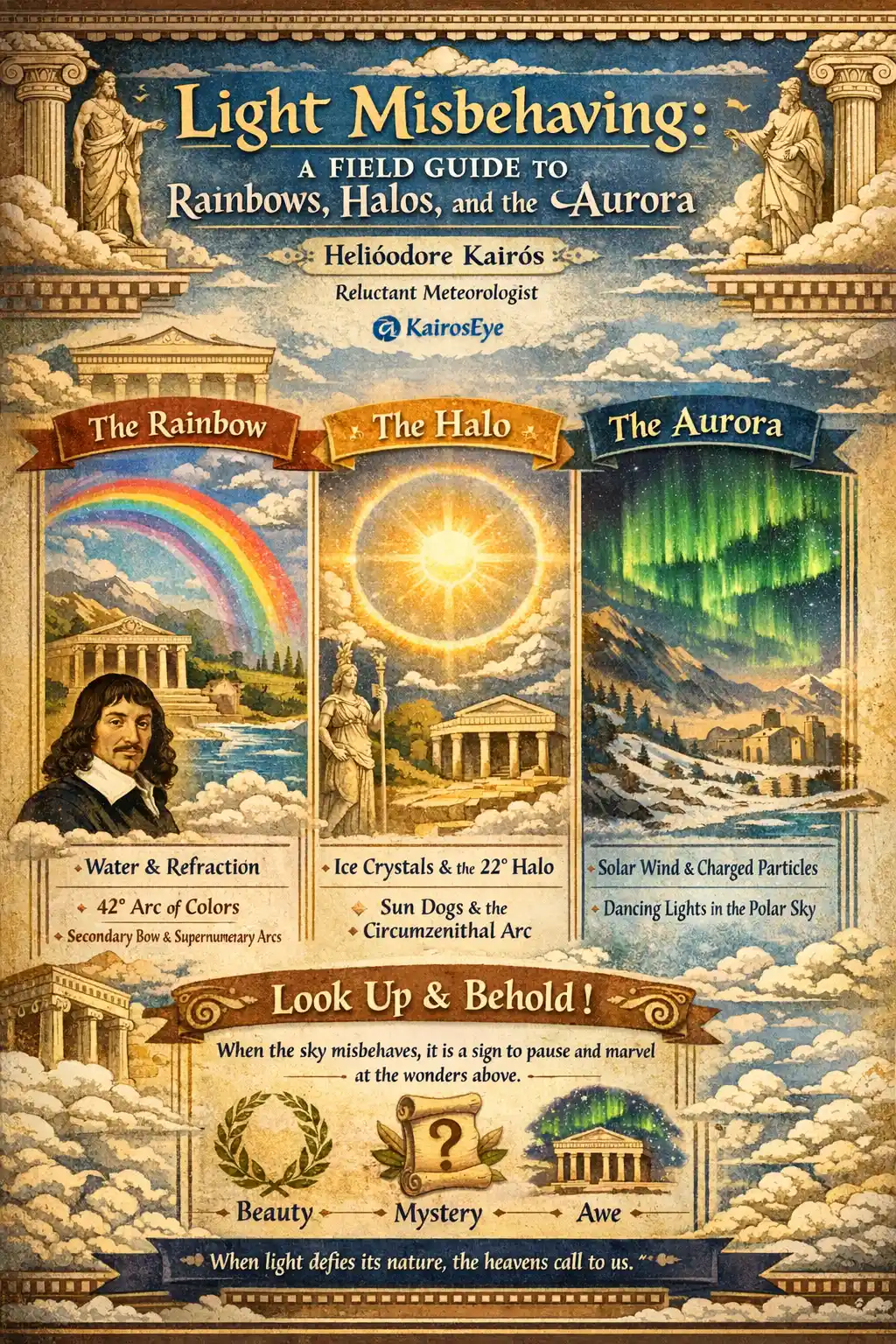
Light Misbehaving: A Field Guide to Rainbows, Halos, and the Aurora
There are moments when light forgets its manners. It stops travelling in polite straight lines, abandons its composure, and throws itself across the sky in extravagant arcs of colour, ghostly rings around the sun, or shimmering curtains of green that have no business existing at all. These are the moments when sensible people stop walking, tilt their heads back, and forget what they were doing. I have observed this behaviour in fishermen, postal workers, and once in a goat, though with the goat I cannot be entirely certain of the cause.
Today I wish to discuss three such occasions of optical misbehaviour: the rainbow, the solar halo, and the aurora. They share almost nothing in their physics. One involves water, one involves ice, and one involves the violence of charged particles slamming into the upper atmosphere at speeds that would make Nikolas Faros's teleprompter catch fire. What they share is simpler than that. They make people look up. And that, I have always maintained, is worth understanding.
The Rainbow, or Descartes's Favourite Parlour Trick
Let us begin with the rainbow, because everyone believes they understand it, and almost nobody does.
The standard explanation goes like this: sunlight enters a raindrop, refracts, reflects off the back of the drop, refracts again on exit, and the different wavelengths of light separate into colours. Red on the outside, violet on the inside, arranged in a tidy arc at roughly 42 degrees from the antisolar point (the spot directly opposite the sun from your perspective). This is correct, as far as it goes. It is also spectacularly incomplete.
The 42-degree figure applies specifically to red light. Violet refracts more steeply and appears at about 40 degrees, which gives the rainbow its roughly two-degree width of colour. Every single raindrop in the sky is producing a full cone of refracted light, but your eye only catches the narrow band at the correct angle. The red you see comes from drops higher in the sky; the violet from drops slightly lower. You are not looking at one rainbow. You are looking at millions of tiny personal light shows, each drop contributing exactly one colour at exactly one angle, and your brain assembles the whole display from the chorus.
René Descartes worked this out in 1637, in an appendix to his Discourse on the Method titled Les Météores. He traced light rays through spherical droplets using the law of refraction and calculated the minimum deviation angle for red light at approximately 137.5 degrees. Subtract that from 180, and you get 42.5 degrees, the angle of the rainbow. The man did this with geometry and a quill pen. I sometimes think about this when I see people photographing rainbows with phones they do not understand.
Isaac Newton, roughly 35 years later, added the crucial piece Descartes was missing: the reason the white light separates into colours at all. Different wavelengths refract at slightly different angles because they travel at slightly different speeds through water. Red (about 700 nanometres) bends least; violet (about 400 nanometres) bends most. The rainbow is not a thing in the sky. It is a consequence of geometry, wave physics, and the precise refractive index of water, which happens to be about 1.33.
The Second Bow and the Dark Band
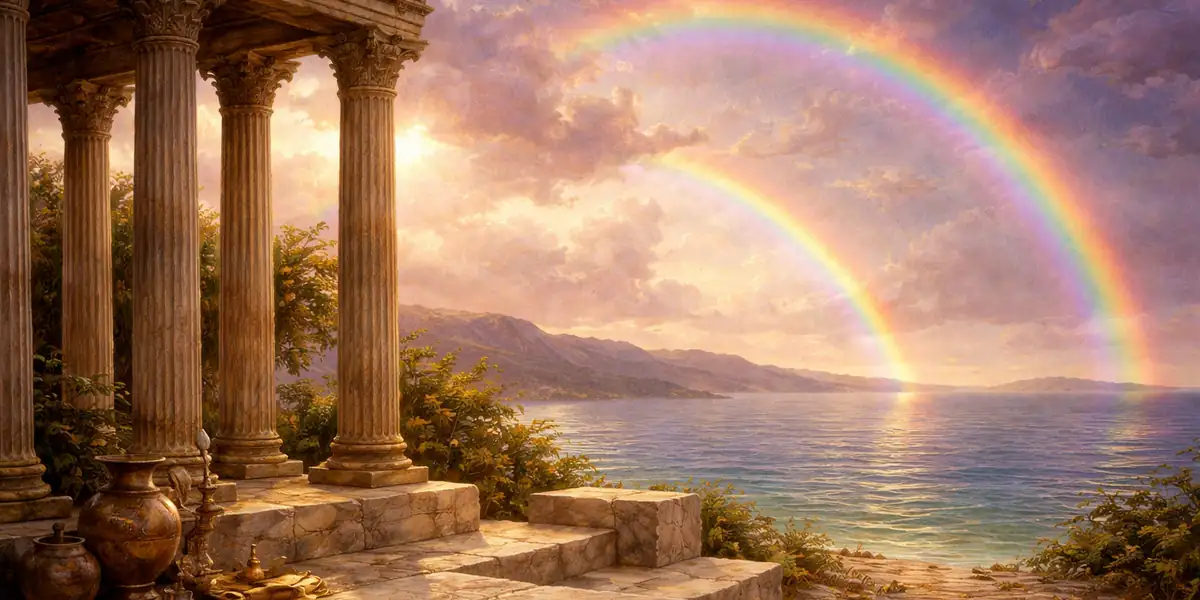
If you have ever seen a secondary rainbow, fainter and broader, hovering above the primary one with its colours reversed, you witnessed light that underwent two internal reflections inside the droplets rather than one. This second bow appears at about 51 degrees from the antisolar point. Each additional reflection absorbs some light, which is why the secondary bow is dimmer by a considerable margin.
Between the two bows lies a region of sky that is noticeably darker than the areas above or below. This is Alexander's dark band, named after Alexander of Aphrodisias, who described it around 200 AD. No light from either the primary or secondary rainbow is scattered into this angular zone, so the sky there appears slightly muted. It is one of those details you will never unsee once you know to look for it.
And there is more, for those inclined to squint. Just inside the primary bow, you can sometimes spot faint, closely spaced arcs of pastel colour. These are supernumerary bows, and they cannot be explained by Descartes's geometric optics at all. Thomas Young, in 1804, demonstrated that they result from wave interference between light rays taking slightly different paths through the same droplet. They are proof, visible to the naked eye, that light is a wave. I find this rather magnificent, though I would not say so in front of Nikolas Faros, who would probably attempt to explain it using a pie chart.
The Halo, or the Sun Wearing a Crown It Did Not Earn
Solar halos are more common than rainbows and less appreciated, which is typical of things that require looking directly at the general vicinity of the sun. The most familiar variety is the 22-degree halo: a pale, luminous ring centred on the sun (or the moon, at night) with an angular radius of 22 degrees.
Where rainbows are born from water droplets, halos are the work of ice. Specifically, hexagonal ice crystals suspended in thin cirrus or cirrostratus clouds at altitudes between 6,000 and 12,000 metres, where temperatures hover around minus 20 to minus 30 degrees Celsius. Light entering one face of a hexagonal crystal prism and exiting through another face encounters a 60-degree geometry. The minimum deviation angle for light passing through a 60-degree prism of ice (refractive index approximately 1.31) works out to roughly 21.8 degrees, which we round to 22 for the sake of conversation.
The inner edge of the 22-degree halo is relatively sharp and faintly reddish. The outer edge dissolves into white. The sky inside the ring is darker than the sky outside, a phenomenon directly analogous to Alexander's dark band in rainbows, though caused by an entirely different mechanism. At mid-latitudes, the 22-degree halo is visible on something like 100 days per year, making it far more frequent than the rainbow. Most people simply never notice, because staring at the sun is not a habit the species has cultivated, and rightly so.
Sundogs and the Circumzenithal Arc
When hexagonal plate crystals fall with their flat faces oriented horizontally, as they tend to do through calm air, they produce parhelia, commonly known as sundogs. These are bright spots that appear at the same altitude as the sun, roughly 22 degrees to its left and right. Their inner edges glow reddish-orange; their outer edges trail off into white or faintly bluish tails pointing away from the sun. They are most vivid when the sun sits near the horizon and the plate crystals are plentiful.
According to The Weathered Pages, entry dated some Tuesday in November, I once observed a pair of sundogs so bright they convinced a neighbour's cat that there were three suns. The cat adjusted its napping position accordingly. I recorded this as a contribution to feline heliophysics.
The circumzenithal arc, meanwhile, is something else entirely. It appears about 46 degrees above the sun, curves around the zenith like a fragment of an inverted rainbow, and displays colours so vivid they seem almost indecent. Red at the bottom, violet at the top, produced by plate crystals that refract light from their top flat face out through a prism side face. It is rare enough that most people live their entire lives without seeing one, and spectacular enough that those who do tend to remember the date.
There is also the 46-degree halo, the light pillars, the tangent arcs, the parhelic circle, and at least a dozen other variations, each caused by specific crystal orientations and geometries. The full taxonomy of ice crystal optics reads like a medieval bestiary, except every creature in it is real and made of frozen water.
The Aurora, or the Sky Remembering It Is Electric
Rainbows and halos are respectable optical phenomena. Light goes in, bends, comes out looking different. The aurora is something altogether less civil.
It begins 150 million kilometres away, on the surface of the sun. The solar corona continuously ejects a stream of charged particles, protons and electrons, travelling outward at 400 to 800 kilometres per second. During coronal mass ejections, that speed can reach 3,000 kilometres per second. This is the solar wind, and it carries with it the sun's magnetic field, stretched and tangled across interplanetary space.
When this wind reaches Earth, it encounters the magnetosphere, the protective bubble generated by our planet's molten iron core spinning several thousand kilometres below your feet. Most of the solar wind is deflected. But when the interplanetary magnetic field points southward (what physicists call "Bz negative"), it can reconnect with Earth's magnetic field lines on the dayside. This opens a door. Solar wind energy pours into the magnetosphere, and charged particles are funnelled along field lines toward the magnetic poles.
These particles, primarily electrons with energies between 1 and 10 kiloelectronvolts, slam into the upper atmosphere at altitudes between 100 and 300 kilometres. They collide with oxygen and nitrogen atoms, exciting those atoms to higher energy states. When the atoms relax back to their ground state, they emit photons. That emission is the aurora.
The Palette
The colours depend on which gas is hit and at what altitude.
Oxygen, when struck at around 110 to 150 kilometres, emits green light at a wavelength of 557.7 nanometres. This is the dominant auroral colour, the one that floods photographs and postcards. The excited state responsible for this emission has a lifetime of about 0.74 seconds, which at those altitudes gives the atom plenty of time to radiate before being disrupted by a collision.
Higher up, above 200 kilometres, oxygen produces red light at 630.0 nanometres. This excited state has a much longer lifetime, approximately 110 seconds, which means it can only survive where the atmosphere is thin enough that collisions are rare. Red aurora tends to appear as a diffuse glow above the green curtains, often visible only during intense geomagnetic storms.
Nitrogen, ionised by the incoming particles, contributes blue and purple tones at wavelengths around 391 to 470 nanometres. These appear at the lower edges of auroral curtains, below 100 kilometres, where the atmosphere is dense enough for nitrogen to dominate.
The result, on a good night, is a sky that looks as though someone spilled several spectra across it and forgot to clean up. The curtains ripple and fold because the charged particles follow magnetic field lines that themselves twist and shift as the magnetosphere responds to changes in the solar wind. An auroral substorm, the sudden brightening and rapid motion that makes the display truly theatrical, typically lasts one to three hours.
Who Gets to See It
Auroras occur in two oval-shaped zones centred on the magnetic poles. Under quiet conditions, these ovals sit at roughly 65 to 70 degrees magnetic latitude. Residents of Tromsø, Fairbanks, and Yellowknife are the regular audience. But during strong geomagnetic storms, measured by the Kp index (a scale from 0 to 9), the oval expands. At Kp 7, aurora can be visible at 50 degrees north. At Kp 9, the maximum, it has been observed from southern France, northern Spain, and once, according to somewhat excitable historical accounts, from Cuba.
As Heraclitus once noted, though in a slightly different context, everything flows. The solar cycle, running roughly 11 years from maximum to maximum, governs how often these storms occur. Solar Cycle 25, the current one, has been unexpectedly vigorous, with solar maximum activity peaking around 2024 and 2025. This has produced several spectacular low-latitude auroral displays, much to the confusion of people in places like London and Tokyo who had never considered that the sky could turn green.
Three Phenomena, One Instruction
What strikes me, sitting on my terrace with The Weathered Pages open to a blank page, is that these three phenomena share an instruction for the observer. The instruction is: stop.
Stop walking. Stop scrolling. Stop worrying about whatever Nikolas Faros said the weekend forecast would be. There is something happening above you that does not require your participation, your opinion, or your smartphone. It requires only that you tilt your head back and pay attention to the fact that photons, which have no mass and no opinions, can produce spectacles that civilisations have interpreted as gods, omens, and bridges to other worlds.
The Norse called the aurora the Bifröst. Aristotle thought rainbows were reflections from clouds acting as mirrors. Filipino folklore held that halos around the moon foretold disaster. All of them were wrong about the mechanism, and all of them were right about the significance. When light misbehaves, it is worth noticing.
Now, I am told that certain modern devices, wrist-worn computers that I shall not dignify with the word "watch," can display UV indices, barometric pressure trends, and even alerts for geomagnetic storms that might produce visible aurora at your latitude. I concede, with the reluctance of a man who has predicted weather by watching ants for four decades, that this is not entirely useless. If such a device tells you the Kp index has reached 7, you might consider stepping outside and looking north. You will not need the device to tell you what you see.
The sky will handle that part on its own.