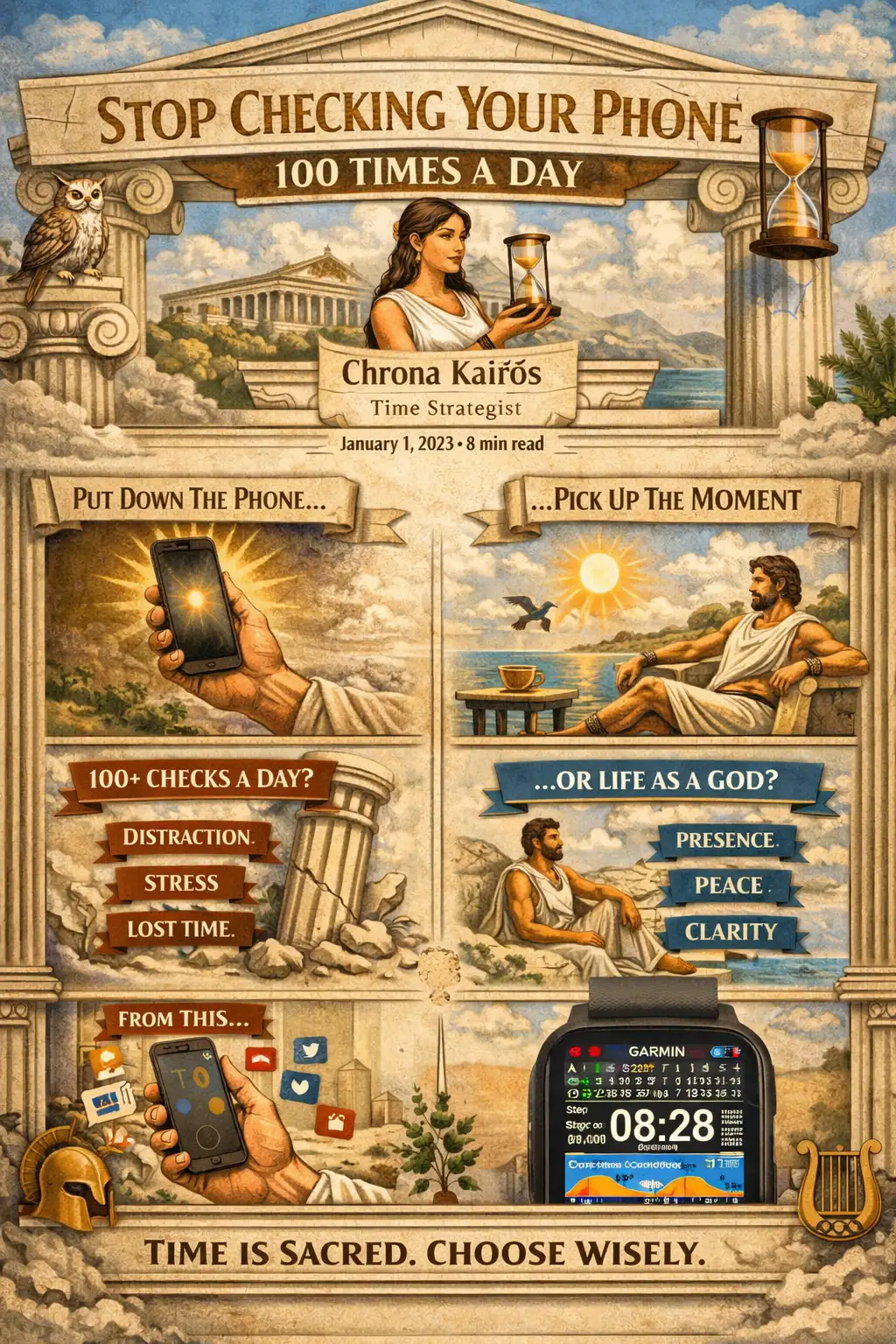
Stop Checking Your Phone 100 Times a Day

I used to check my phone before my feet hit the floor.
Not for anything important. Not for emergencies. Just the reflex. Screen on, brightness assaulting my retinas at whatever ungodly hour I'd set my alarm, a quick scroll through notifications I'd collected overnight, most of which could have waited until I was dead and it still wouldn't have mattered.
I'm telling you this because I want you to know where I'm writing from. Not an enlightened mountaintop. Not some digital-detox retreat where people pay four thousand euros to not use Wi-Fi for a week. I'm writing from the other side of a phone addiction that was (if we're being honest, and I always am, sometimes painfully so) significantly worse than average.

The studies say about a hundred pickups per day. I was north of a hundred and fifty. I know this because I eventually counted. But I'll get to that.
How I got here
In Zürich, checking your phone constantly wasn't a problem. It was professionalism. I worked at an architecture firm where the schedules were tighter than the floor plans. Slack at 7am. Calendar invites at 11pm. Email threads that reproduced overnight and expected responses before coffee.
I scheduled my bathroom breaks in my calendar. I've said this before. I say it again because the wince it produces is useful: it means you recognized something. Hold onto that feeling. It's trying to tell you something your productivity system won't.
My phone was my leash and I was grateful for it. It told me where to be, when to breathe, what to prioritize. I called it being organized. My body called it something else. It shut down at twenty-eight, quietly, in the middle of a client meeting, like a laptop that finally hits 0% and powers off without asking permission.
Three months off. A flight back to my father's island. And the terrifying experience of having nothing in my calendar for the first time in six years.
What my father said
Héliodore, reluctant meteorologist, full-time sky observer, the kind of man who considers Wi-Fi a personal affront, watched me scroll through my phone on his stone terrace for three days without saying a word.
On the fourth day, he put down his coffee, adjusted his pipe (the pipe is always involved in his most devastating observations) and said:
"You look at that thing more often than I look at the sky. And I am, as you know, professionally obligated to look at the sky."
I opened my mouth to argue. Nothing came out. He went back to his coffee.
He was right. Infuriatingly, precisely, unnecessarily right, in that way he has of delivering a truth so casually you almost miss how deep it cuts.
I didn't change that day. Or that week. But the sentence stuck. Like a splinter. Small enough to ignore, sharp enough that you can't quite.
The week I counted
About a year later, in Lisbon, one of those tiled cafés near Alfama where the coffee is strong and the Wi-Fi is aspirational, I decided to track my phone pickups for a week. Not what I did after picking it up. Just the impulse. The reason my hand moved before my brain caught up.
I carried a small notebook. Yes, like my father. No, I will not discuss the irony. Next to each mark, I wrote one word: why.
Seven days. The pattern was clear by day three and depressing by day five. About a third of pickups were for the time. One in ten for the weather. Another fifteen percent, the calendar. Add it up. More than half of my phone pickups were for three pieces of information that have lived on wristwatches since before my father was born.
The rest split between notifications I didn't need and pure reflex, my hand going to my pocket like a tic, reaching for something that wasn't even there. The word that appeared most often in my notebook? Nothing. Literally nothing. I reached for my phone and couldn't say why.
The embarrassingly simple part
Here's where I lose anyone expecting a sophisticated twelve-step framework.
I'd been wearing a Garmin for months. Time on the face. Temperature. Next calendar event. All right there, available at a wrist turn. No screen to unlock. No notification tray lurking underneath. No algorithm whispering while you're here, have you seen what your former colleague posted about their incredible new job?
The answer had been on my wrist the entire time. I just kept reaching past it into my pocket for the more dangerous version.
The first week I consciously redirected the reflex, wrist instead of pocket, I felt ridiculous. Glance at wrist. See the time. Done. No rabbit hole. No dopamine slot machine. Just the answer, bare and boring, with nothing attached to it.
By the second week, it was just how I checked. I now look at my watch a few times a day. I used to reach for my phone a few times a minute. The math is not subtle.
What actually changes
Here's the part I didn't expect: it's not just about the phone. It's about what fills the space once the phone is gone.
When you stop reaching for a screen fifty times a day, you notice things. The sound of the café. The way afternoon light moves across a table. The person across from you who was talking while you were "just quickly checking." You start finishing thoughts instead of interrupting them. Conversations get longer, not because you're trying, but because nothing is pulling you away.
It sounds small. It isn't. The phone wasn't just stealing minutes. It was slicing your attention into fragments too thin to hold anything real. Every pickup, even the two-second ones, resets your brain. You come back to what you were doing, but slightly less present each time. Multiply that by a hundred and you get a day that felt busy but produced almost nothing of value.
The watch breaks this cycle because it gives you information without context-switching. You glance, you know, you move on. Your brain stays where it was. That's the difference nobody talks about: it's not about saving time, it's about protecting the quality of the time you already have.
What I tell people now
I work with people, founders mostly, sometimes teams, who have that glazed look I recognize from my own mirror in Zürich. Calendars with no white space. Phones that never leave their hands.
I ask them to try something. Leave the phone in another room for two hours. Just two. Keep the watch. See what happens. The first thirty minutes feel like withdrawal, and I use that word deliberately. The hand goes to the pocket, finds nothing, and the brain panics slightly. By the second hour, something shifts. They start thinking in complete sentences again.
Then I do the uncomfortable part. I ask them to open their calendar, point at any item, and ask: why? Not what it's about. Not who called it. Just, why is this in your life?
If they can't answer in one sentence, it's stealing from them. Same logic for every phone pickup. Why did you just reach for it? If the answer is "I don't know," the phone won.
Your phone does three thousand things. A good watch face does three. That's not a limitation. That's the whole point.
My father would say the problem with modern technology is that it answers questions you never asked. Every unlock opens a door into a room full of strangers shouting things you didn't want to know. A watch doesn't open doors. It tells you the time and shuts up. That's respect.
One last thing
I write once a year. Not because I have nothing to say (ask anyone who's sat across from me in a café for longer than ten minutes) but because saying less is the entire point.
Here's what I know. After the burnout. After the bathroom breaks. After three years of watching people stare at their calendars and realize half of it is noise:
A hundred phone checks a day is not a habit. It's a leak.
Time is not a resource to maximize. It's a medium to shape, like space, like light, like the silence between notes in music.
Your wrist already has what you're reaching for. Time. Weather. The one thing that matters today. Nothing else.
I keep a gratitude journal. Yes, I know how that sounds. But today's entry is short: I'm grateful for the things that do less.
Stop reaching for your pocket. The answer is closer than you think.