Heat, Frost, and Moving Air: The Thermodynamics of Outdoor Discomfort

There is a particular kind of betrayal that only a thermometer can deliver. You glance at it through the window, see a perfectly reasonable minus five, put on your coat accordingly, step outside, and discover within thirty seconds that the air has teeth. The thermometer was not lying, exactly. It simply omitted the part where a twenty-knot wind turns minus five into something that will freeze exposed skin in under ten minutes.

This is wind chill. It is not the only way your thermometer deceives you, but it is the most immediately painful.
The inverse happens in summer. The forecast says thirty-two degrees. Manageable. You have survived thirty-two degrees before. But the forecast neglected to mention eighty percent humidity, which means your body's primary cooling mechanism, the evaporation of sweat, has been rendered nearly useless. The effective temperature your cardiovascular system is fighting against is closer to forty-five. That is not discomfort. That is the beginning of a medical emergency.
Between these two extremes lives an entire taxonomy of thermodynamic phenomena that determine whether you are merely uncomfortable or genuinely in danger. They are poorly understood by the general public, routinely mangled by television meteorologists (I will not name names; Nikolas Faros), and profoundly important to anyone who spends time outdoors, which, if you are wearing a GPS watch on your wrist, presumably includes you.
What Wind Chill Actually Is
Wind chill is not a temperature. This distinction matters, and almost nobody makes it. Wind chill is a measure of the rate of heat loss from exposed human skin caused by the combined effect of air temperature and wind speed. The air itself is not colder because of the wind. A bottle of water left outside at minus ten in a gale will freeze at exactly the same rate as a bottle of water left outside at minus ten in dead calm. The thermodynamic properties of water do not care about wind.
Your skin, however, cares enormously. In still air, your body maintains a thin layer of warmed air against the skin surface, a kind of thermal boundary layer. Wind destroys this layer. It strips the heated air away and replaces it with air at ambient temperature, over and over, accelerating the rate at which your body loses heat. The faster the wind, the faster the stripping, the faster you cool toward the ambient temperature.
The concept was first quantified by Paul Siple and Charles Passel, two American researchers working in Antarctica in 1945. Their experiment was admirably straightforward: they hung plastic cylinders filled with water from a pole at the Little America base and measured how quickly they froze under various combinations of temperature and wind speed. From this, they derived the original Wind Chill Index, expressed in watts per square metre, a unit that was scientifically rigorous and utterly meaningless to anyone trying to decide whether to wear a scarf.
For decades, weather services dutifully reported wind chill in watts per square metre, and the public dutifully ignored the number. In 2001, the United States and Canada jointly developed a new formula, this time based on actual human trials. Volunteers walked on treadmills in a refrigerated wind tunnel at the Defence and Civil Institute of Environmental Medicine in Toronto, with thermal sensors affixed to their faces. The resulting North American Wind Chill Index produces an output in degrees, designed to approximate how cold it "feels" on exposed skin at a walking pace, at face height, in shade.
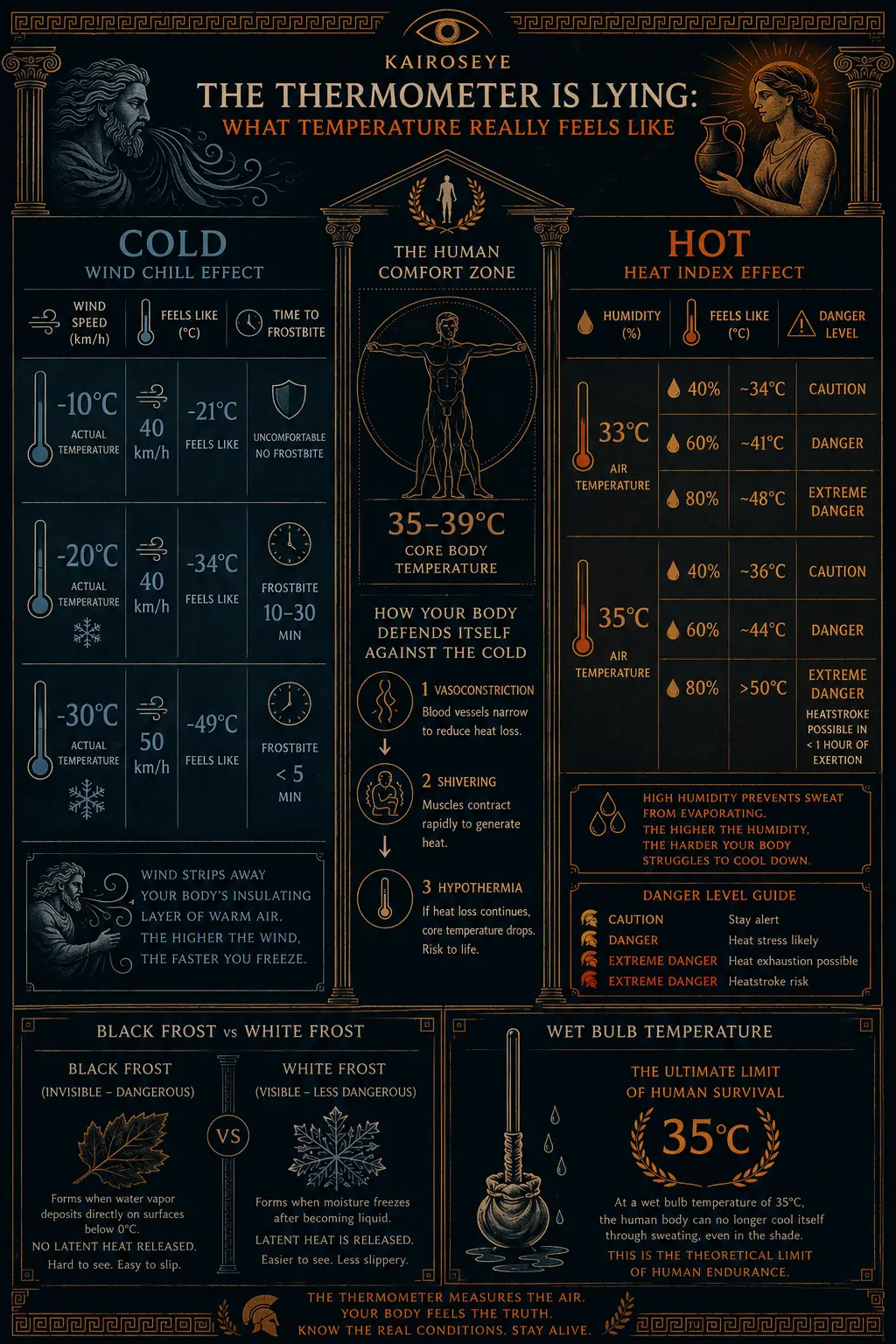
The numbers are sobering. At an air temperature of minus ten Celsius with a wind speed of forty kilometres per hour, the wind chill is approximately minus twenty-one — punishing, though not yet a frostbite emergency for a properly dressed adult. At minus twenty with the same wind, the wind chill drops to minus thirty-four, and exposed skin can freeze in ten to thirty minutes. At minus thirty with fifty-kilometre winds, the value plunges to minus forty-nine, and frostbite can occur in under five minutes.
According to The Weathered Pages, entry dated some January in the late 1990s: "Wind from the northeast. Flask of coffee frozen in the satchel before I reached the observatory path. The thermometer read minus eight. The thermometer is a coward and a liar."
The Thermal Envelope You Carry With You
To understand why wind chill matters so much, you need to appreciate that your body is, in thermodynamic terms, a heat engine operating within an extraordinarily narrow temperature band. Your core temperature is maintained at approximately 37 degrees Celsius, and a deviation of just two degrees in either direction initiates a cascade of increasingly desperate physiological responses.
When heat loss exceeds heat production, your body begins with vasoconstriction, narrowing blood vessels in the extremities to reduce blood flow to the skin surface and preserve core temperature. Your fingers go white. Your toes go numb. This is your body sacrificing the outposts to defend the capital.
If that is insufficient, shivering begins, an involuntary contraction of skeletal muscles that generates heat through metabolic activity. Shivering can increase your metabolic rate by a factor of five, but it is exhausting and unsustainable. If cooling continues, core temperature drops below thirty-five degrees, and you enter hypothermia. Confusion sets in. Decision-making deteriorates. People in the early stages of hypothermia frequently make the situation worse by removing clothing, a phenomenon called paradoxical undressing, caused by a final surge of blood to the skin surface as vasoconstriction fails.
Wind accelerates this entire sequence. In calm air at minus fifteen, a properly dressed person might function outdoors for hours. Add a thirty-knot wind, and the timeline compresses dramatically. The heat your body produces is carried away faster than it can be replaced.
The Other Side: When Humidity Becomes a Weapon
If wind chill is about losing heat too fast, the heat index is about not losing it fast enough.
The human body's primary cooling mechanism in hot conditions is evaporative cooling: sweating. Your eccrine glands produce sweat, which sits on the skin surface and absorbs heat as it evaporates, carrying thermal energy away from the body. This is efficient, elegant, and entirely dependent on one variable: the vapour pressure gradient between your skin and the surrounding air.
When humidity is low, evaporation is rapid, and you cool efficiently. When humidity is high, the air is already saturated with water vapour, evaporation slows to a crawl, and your sweat simply sits on your skin, achieving nothing except discomfort. Your core temperature begins to rise.
The heat index, sometimes called the "apparent temperature" or the "humiture," was developed by Robert G. Steadman in 1979. His model accounts for the combined effect of air temperature and relative humidity on the human body, assuming a person of average height and weight, walking at a slow pace in the shade. The formula is a regression equation derived from a more complex physiological model that considers vapour pressure, skin resistance, clothing, metabolic rate, and several other variables.
The results are instructive. At 33 degrees Celsius with 40% relative humidity, the heat index is approximately 34 degrees, barely noticeable. The same 33 degrees at 80% humidity produces a heat index of roughly 48 degrees. At 35 degrees with 80% humidity, the heat index exceeds 50 degrees, and heatstroke becomes a real possibility within an hour of sustained exertion.
Nikolas Faros announced last July that Athens was experiencing "thirty-four degrees, a pleasant summer day." He delivered this assessment from a television studio with, one assumes, aggressive air conditioning. He did not mention that the relative humidity was seventy-five percent, producing an effective heat index of approximately forty-nine degrees. Three elderly residents of Piraeus were hospitalised that afternoon. Nikolas's hair remained perfect.
Black Frost: The Silent Killer of Orchards
There is a third phenomenon that deserves more attention than it receives, precisely because it is invisible.
White frost, the kind you see on grass and windshields on cold mornings, forms when water vapour in the air deposits directly onto surfaces as ice crystals. It is beautiful, photogenic, and relatively benign. It requires air humidity, calm conditions, and surface temperatures below zero. You see it. You know it is cold.
Black frost is what happens when the temperature drops below freezing but the air is too dry for ice crystals to form. There is no visible frost. No white coating. No warning. The ground looks bare and ordinary, but plant cells are freezing from the inside, their intracellular water forming ice crystals that rupture cell membranes. Leaves, stems, and fruit darken and collapse. The blackened, necrotic tissue is what gives the phenomenon its name.
Black frost is the terror of viticulture, of citrus farming, of anyone who grows anything in regions where late spring freezes are possible. A white frost on a vineyard is a warning; the vines are stressed but often survive. A black frost is a sentence. The Burgundy frost of April 2016 destroyed an estimated 50% of the Chablis appellation's production. Many growers reported that the damage was worst in areas where there had been no visible frost at all, the dry air having dropped to minus four without leaving any trace on the surface.
The physics is straightforward. White frost actually releases latent heat as water vapour transitions to ice (the process of deposition releases approximately 2,830 kilojoules per kilogram). This released heat slightly moderates the temperature at the plant surface. Black frost, occurring in dry air with no phase transition of atmospheric moisture, offers no such buffer. The temperature drop proceeds unmitigated.
As Heraclitus once noted, though in a slightly different context, you cannot step into the same frost twice. He was talking about rivers, naturally, but the principle applies: each frost event is a unique combination of temperature, humidity, wind, radiative cooling, and topography that will never precisely repeat itself.
Wet Bulb Temperature: The Threshold of Survivability
There is a fourth metric, less well known but arguably the most consequential of all: the wet bulb temperature.
Imagine wrapping a standard thermometer in a damp cloth and allowing air to flow over it. The evaporating water cools the thermometer, and it reads lower than the dry bulb temperature. The difference between the two readings indicates the evaporative potential of the air. When the wet bulb temperature equals the dry bulb temperature, the air is fully saturated, and no evaporative cooling is possible.
In 2010, Steven Sherwood and Matthew Huber published a paper in the Proceedings of the National Academy of Sciences identifying a wet bulb temperature of 35 degrees Celsius as the theoretical upper limit of human survivability. At this threshold, even a naked person in the shade with unlimited water cannot shed metabolic heat fast enough to maintain core temperature. Death follows within hours.
This was once considered a theoretical curiosity, a condition that, while physically possible, did not occur naturally on Earth's surface. It has since been recorded. Weather stations in the Persian Gulf, the Indus Valley in Pakistan, and parts of subtropical Asia have measured wet bulb temperatures exceeding 33 degrees, with at least two documented instances approaching 35 degrees in brief spikes. The duration was short, but the threshold was approached.
For anyone exercising outdoors, the danger begins well below 35. A wet bulb temperature of 28 degrees is considered dangerous for sustained physical activity. At 30 degrees, even moderate exertion becomes hazardous for healthy adults. Endurance athletes, hikers, and anyone wearing a GPS watch while running trails in tropical or subtropical climates should treat wet bulb temperature with considerably more respect than they treat the standard forecast.
The Instrument and the Experience
There is a reason I have spent forty years recording not just temperature, humidity, and wind speed in The Weathered Pages, but also my own subjective experience of each observation. "Clear morning, minus twelve, light breeze, comfortable in wool." "Overcast, plus two, forty-knot gusts, profoundly miserable." The numbers alone do not capture the reality of being a warm-blooded organism in a thermodynamically hostile environment.
The modern proliferation of "feels like" metrics on weather applications is, I concede with some reluctance, a step in the right direction. Wind chill and heat index attempt to bridge the gap between what the atmosphere is doing and what your body experiences. They are crude approximations, built on simplified models of human physiology, but they are vastly more useful than raw temperature alone.
A GPS watch on your wrist, equipped with a temperature sensor, a barometric altimeter, and in some cases a humidity sensor, can provide real-time data about the conditions your body is actually confronting. I find this fact personally irritating, because it means that a small plastic rectangle does, in some narrow technical sense, a better job of environmental assessment than glancing at the sky, which is what I have been doing for four decades and what Heraclitus was presumably doing before me.
But the watch cannot tell you about black frost. It cannot warn you that the dry, apparently harmless minus three on its display is silently destroying the lemon grove down the hill. It cannot convey the particular menace of a Persian Gulf afternoon where the wet bulb temperature is climbing toward unsurvivable levels while the forecast blithely reports "thirty-eight degrees, partly cloudy."
For that, you still need understanding. The kind that comes from knowing, not just reading, that the thermometer is only telling you part of the story.
My pipe has gone out. The wind, I note, is from the north.